
Whether implementing Six Sigma in Munich or Manhattan, Paris or Prague, certain common factors are critical for success. Nonetheless, how one successfully applies these factors is culturally dependent.
Universal Critical Success Factors
Accepting the General Electric definition of Six Sigma as “completely satisfying customers’ needs profitably” means that Six Sigma requires a company-wide initiative to dramatically improve process performance. It means that every employee in a company learns a structured approach to managing improvement projects and solving problems using facts and taking the customer’s perspective. It means on-target performance with minimum variation. With those givens in mind, here are some of the factors of Six Sigma which are considered universal:
- Clear Project Chartering and Sponsorship: Defining the business case for the project, scope, baseline measures, resources required, potential risks and naming a senior executive as mentor/sponsor for the life of the project.
- Identification of Customers and Their Needs: Identifying who receives the outcome of the process and what is critical to quality from their perspective.
- Application of Measures: Describing the outcomes (Ys), process and input (x’s) measures upon which the project will focus.
- Analysis of Causal Variables: Using quantitative methods to define causal relationships and the vital few variables that impact the desired outcome.
- Improvement of Mean Performance and Sigma Levels: Reducing variability, not just average performance.
- Standardization and Application of Control Charts: Putting in place the tools to track performance on an ongoing basis.
Case studies of two European companies show how they successfully maintained these foundation elements yet adapted Six Sigma to their national and company cultures.
Siemens – Business Improvement with Six Sigma as Toolkit
Siemens is an example of a German multinational company that carefully thought through its approach to Six Sigma, with a focus on improving collective business performance. Important to Siemens was how Six Sigma fits with other improvement initiatives such as ISO 9000 or the European Foundation for Quality Management (EFQM) Business Excellence Model. Not one to take on the “flavor of the month,” Siemens carefully assessed what contribution Six Sigma could make and integrated it into a comprehensive, logical approach to improvement called Top+ Quality.
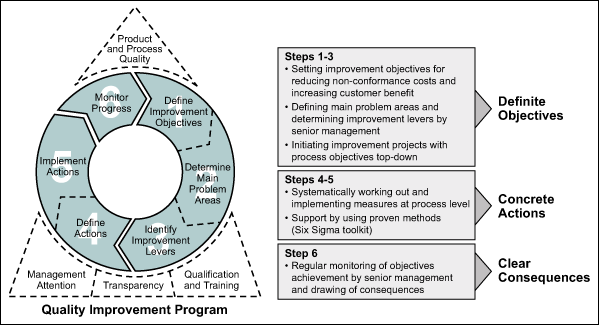
Using the framework illustrated in Figure 1, Siemens clearly spells out the responsibilities of senior managers as well as project leaders in business improvement. In Steps 1 through 3, senior managers identify in measurable terms the business benefits they want to achieve through quality improvement – reductions in non-conformance costs, improved benefits to customers or both. They use the results of benchmarking or EFQM assessments to help identify problem areas and set improvement targets. In identifying the drivers or levers of improvement, senior managers can select from them the ones best solved through Six Sigma (i.e., those related to processes or input variables)
Other improvement levers, for example, a customer database, are identified and addressed using different improvement methods. Where appropriate, Six Sigma projects are then clearly scoped, team leaders are assigned and training is linked to concrete actions – Steps 4 and 5. Senior management stays involved in two ways. As illustrated in Step 6, their job is to be sure the critical parameters related to Six Sigma and other improvement projects are defined, monitored and responded to accordingly. Here, Siemens makes the link to balanced scorecards which are used in many divisions. The supporting elements of the Top+Quality improvement circle also are the responsibility of senior management – devoting time and attention, making processes and improvement activities visible/transparent, selecting the right project leaders, and giving these leaders appropriate training and time to see their actions through to results.
The benefit of the Siemens approach is the top-down link to business improvement objectives, the distinction between process/input levers and other levers which are important but not suited for Six Sigma, and finally the highlighting of senior management’s role throughout the process. By positioning Six Sigma as a toolkit in a larger improvement methodology, Siemens concentrates on overall business improvement and effectiveness.
Ericsson – A Vehicle for Individual and Organizational Change
Ericsson is a Swedish multinational that is an example of a company Ericsson whose approach to Six Sigma balances the needs of the company with the needs of the individuals on whose support success depends. Because implementing Six Sigma often entails radical changes, receptivity to change – for an individual as well as an organization – is an important predictor of success. Clairy Wiholm, a Six Sigma deployment manager for Ericsson, researched the variables that influence an individual’s readiness for change. Figure 2, provided by the Ericsson Quality Management Institute, outlines these elements of change capability.
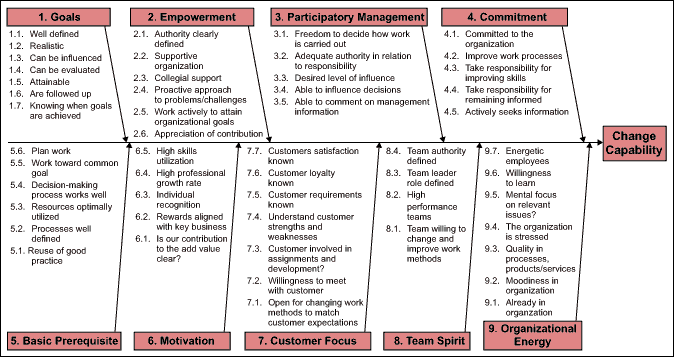
Having defined and validated the elements of change capability, the Ericsson team leading the Six Sigma implementation could measure and help prepare those for whom Six Sigma is an appropriate improvement approach. Wiholm and her colleagues stress that it is not important that the entire population in a given business unit be “fit for change.” As depicted in Figure 3, there will be a normal distribution in people’s reaction to change.

By making the topic of change explicit, a number of critical questions were discussed and addressed: What is a given business unit’s average change capability? What profile do the business leaders have? How can the 20 percent who are early Six Sigma adopters help show the majority who “go with the flow” that there is something in it for them? These are issues critical to when and how each business unit embraces Six Sigma. Once a business unit has decided to proceed, modules of the Six Sigma training specifically help participants understand why they react to change as they do, and help them become more fit for change, thereby increasing the chances of their success in Six Sigma.
In addition, because Ericsson recognizes the need to engage on the individual level, it designed its Six Sigma training with an opportunity for “contracting” between project leaders and their managers. The manager of each participant in a Six Sigma Black Belt course attends one day during the first week of training. This gives time off-line for the manager to clarify a number of critical elements – why the person was selected, why the project was chosen, how the success or failure of the project will affect the individual’s career. Likewise, the project leader can negotiate for the time needed to work on the project assignment and the support he/she will need from the supervisor. Particularly in companies where Black Belts are balancing project work with operational responsibilities, contracting for time to work on assignments is vital to the success of Six Sigma.
Ericsson demystified change in measurable and practical terms. By weaving change management modules and contracting sessions into Six Sigma training Ericsson significantly increased the probability of success.
Conclusion: Uncompromising Yet Flexible
Bedrock principles of Six Sigma should not be compromised regardless of the country. However, to be successful, a company has to fit Six Sigma into the organizational and cultural context in which it is working. In Germany, support for Six Sigma is gained by showing how it relates to an integrated concept of improvement. This includes acknowledging the value of existing approaches, and clarifying both the ultimate goal and the steps for getting there. In Scandinavia, the focus must be on the individual and the benefits that Six Sigma offers him/her. This includes de-emphasizing stretch goals imposed from above, communicating the personal development the individual acquires through Six Sigma, and acknowledging and working with the factors that influence the capability to change.
The art of successfully implementing Six Sigma is to be uncompromising about the critical ingredients for success while being flexible to the cultural context in which one is working.
