
Key Points
- DMAIC is a methodology aimed at problem-solving and process improvement.
- It is one of the most useful tools at your disposal in Six Sigma.
- You can add additional methodologies after you’ve established the DMAIC pipeline in your process improvement.
The Six Sigma DMAIC (Define, Measure, Analyze, Improve, Control) methodology can be thought of as a roadmap for problem-solving and product/process improvement.
Most companies begin implementing Six Sigma using the DMAIC methodology and later add the DFSS (Design for Six Sigma, also known as DMADV or IDDOV) methodologies when the organizational culture and experience level permits. You can read the main differences between DMAIC and DMADV, but we’ll focus on the DMAIC in this article.
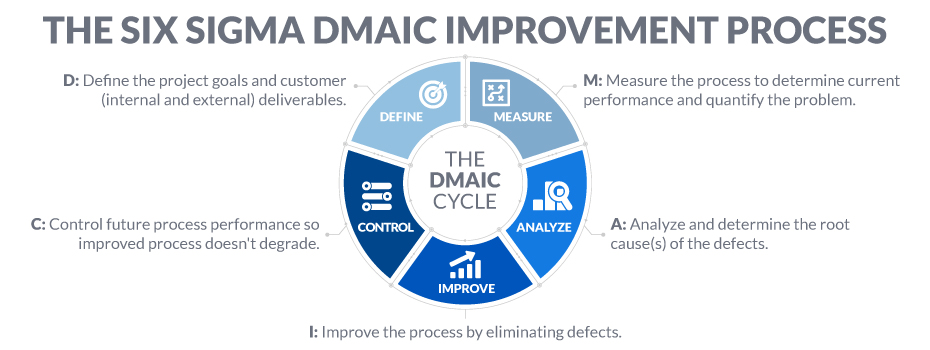
While the DMAIC methodology presented above in the graphic and below in the listing may appear linear and explicitly defined, it should be noted that an iterative approach may be necessary – especially for Black Belts and Green Belts that are new to the tools and techniques that make up DMAIC. For instance, you may find that upon analyzing your data (Analyze phase) you did not gather enough data to isolate the root cause of the problem. At this point, you may iterate back to the Measure phase.
Sticking to the Plan
So, why follow our DMAIC roadmap? If your organization is new to integrating Six Sigma, there likely isn’t the necessary infrastructure to focus on the right sort of process improvement. However, by following our roadmap and utilizing the tools given, you’re on the fast track for success.
The Roadmap
In addition, prior knowledge of the tools and techniques is necessary in determining which tools are useful in each phase. Remember, the appropriate application of tools becomes more critical for effectiveness than correctness, and you don’t need to use all the tools all the time.
| DMAIC Phase Steps | Tools Used |
| D – Define Phase: Define the project goals and customer (internal and external) deliverables. | |
|
|
| Define Tollgate Review | |
| M – Measure Phase: Measure the process to determine current performance; quantify the problem. | |
| |
| Measure Tollgate Review | |
| A – Analyze Phase: Analyze and determine the root cause(s) of the defects. | |
| |
| Analyze Tollgate Review | |
| I – Improve Phase: Improve the process by eliminating defects. | |
| |
| Improve Tollgate Review | |
| C – Control Phase: Control future process performance. | |
|
|
| Control Tollgate Review | |
As you can see, the power of the Six Sigma DMAIC methodology lies in the structure and the rigor. Of the hundreds of TQM tools that have been developed over the years, the most important ones (described above) are taught in detail by consultants to Black Belts and Master Black Belts.
Other Useful Tools and Concepts
Ready for a bit more? So, we’ve covered the ins and outs of DMAIC, but what about how it compares to the likes of PDCA? Our exhaustive guide covers both approaches as well as where to use each when you’re looking to get your production back on track.
Further, understanding what Six Sigma means in a variety of contexts can be quite useful. This isn’t just a methodology after all, but something far more comprehensive.
