
This article introduces the concept of earned value management (EVM) indexes, a project assessment technique, and control charts, a statistical tool for monitoring variation in a process, and describes how both may be used in tangent to capture more insight from project performance.
What to Know About EVM Indexes
EVM is a project management technique for measuring project performance and progress; although not specifically a tool for process improvement, its capabilities make it a good addition to a Lean Six Sigma practitioner’s tool belt. EVM integrates scope, cost and schedule to assess the performance of a project. After baseline costs and a schedule are developed, actual performance is measured with regard to the baseline values. The following are the key metrics and performance indexes of the EVM technique.
- Planned value (PV): The authorized budget allocated to the work to be accomplished for an activity.
- Earned value (EV): The value of work performed expressed in terms of the approved budget assigned to the work for an activity.
- Actual cost (AC): The actual cost incurred in work performed for an activity.
- Schedule performance index (SPI): The efficiency of the time utilized on the project. It is calculated as the measure of progress achieved compared to the progress planned for a project.
SPI = EV / PV
SPI < 1 means the project is behind schedule
SPI = 1 means the project is on schedule
SPI > 1 means the project is ahead of schedule
- Cost performance index (CPI): The efficiency of the resource (cost) utilized on the project. It is calculated as the measure of the value of work completed compared to the actual cost or progress made on the project.
CPI = EV / AC
CPI < 1 means the project is over budget
CPI = 1 means the project is on budget
CPI > 1 means the project is under budget
- Critical ratio (CR): This indicator combines both CPI and SPI to represent the project status. This indicator takes into account cost and schedule trade-offs.
CR = CPI * SPI
CR < 1 means poor project performance
CR = 1 means project performance is on target
CR > 1 means good project performance
EVM indexes are point estimates; they represent the performance of the project at a given reporting instance. They do not provide information about project performance over a period of a time and thus do not capture the trend of project performance.
EVM for Widgets
Consider a project to deliver 10 widgets in 10 months at an estimated project cost of $10,000. It is assumed that budget usage and widget production are expected to proceed uniformly over the duration of the project. Also assume that, to measure project performance, the EVM index is calculated at the third and seventh months of the project.
On the third month, the project status is as follows:
- Expected number of widgets to be delivered = 3 (one widget per month over the course of the 10 months of the project)
- Actual number of the widgets delivered = 2
- Actual cost = $4,000
The planned value is calculated as:
| PV | = | (total cost of the project apportioned equally over the project duration) * (actual duration of project to date) |
| = | ($10,000 / 10) * 3 | |
| = | $3,000 |
Thus, the actual amount of work delivered (expressed in dollars) is:
| EV | = | (number of widgets delivered/total number widgets to be delivered) * (total cost of the project) |
| = | (2 / 10) * $10,000 | |
| = | $2,000 |
On the seventh month, the project status is as follows:
- Expected number of widgets to be delivered = 7
- Actual number of the widgets delivered = 8
- Actual cost = $6,000
The planned value is calculated as:
| PV | = | (total cost of the project apportioned equally over the project duration) * (actual duration of project to date) |
| = | ($10,000 / 10) * 7 | |
| = | $7,000 |
The actual amount of work delivered (expressed in dollars) is:
| EV | = | (number of widgets delivered/total number widgets to be delivered) * (total cost of the project) |
| = | (8 / 10) * $10,000 | |
| = | $8,000 |
The table below summarizes these calculations, as well as provides the SPI, CPI and CR for the project.
| Project Performance Snapshot | |||||||
|
Month |
PV |
EV |
AC |
SPI = |
CPI = |
CR = |
Project Performance |
|
Three |
$3,000 |
$2,000 |
$4,000 |
0.66 |
0.5 |
0.33 |
Bad |
|
Seven |
$7,000 |
$8,000 |
$6,000 |
1.14 |
1.33 |
1.52 |
Good |
What to Know About Control Charts
In contrast to EVM indexes, control charts display process data over time against process control limits. Control limits define the area of three standard deviations (by default) on either side of the centerline, or mean, of data plotted on a control chart wherein expected variation is observed. There are three basic components of control charts:
- A centerline representing the mean value of the data points
- Horizontal border lines – upper control limits (UCL) and lower control limits (LCL) – that define limits of common cause variations
- Data points plotted over time
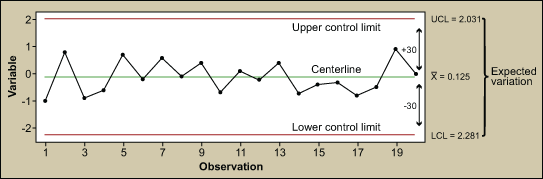
Figure 1: Standard Control Chart
A control chart is used to determine whether a process is stable (contains only common cause variation) or if it is subject to special cause variation. Common cause variation is the predictable and expected variation present in the process due to its inherent nature. Special cause variation is variation introduced in the process by nonrandom events or factors external to the process. If special cause variation is present in the process, then the process is said to be in an unstable state.
Combining EVM Indexes and Control Charts
Among all of the EVM indexes, the CR is the only metric that captures the essence of both cost and schedule measures of the project and succinctly describes the project status at any point in time. Ideally the CR of the project should be one, but in practice the CR varies over the project duration, as was seen in the widget example above. A control chart of the CR will capture the variation in the ratio, as well as:
- Indicate whether project performance is stable or not over the project’s duration.
- Highlight instances of abnormal CR (unexpected variation) during the project’s duration.
- Indicate any special trend or pattern in project performance.
- Predict future project performance from stable performances.
The Intersection of EVM Indexes and Control Charts
Critical ratios in conjunction with control charts can be used to gather greater insight into project performance. Critical ratios are used as a performance measure index across industries. The following example of using control charts to monitor the CR is from the software industry.
A typical software development lifecycle project consists of the following phases: requirements gathering, design, development, testing, implementation and support. One way to group the project performance data is by project phase (another option would be to group the data by month or quarter). Use Xbar-S control charts to plot the CRs (continuous data) over the project duration. Interpret the outcome of the control chart as follows:
- If all the data points are within the control limits and no special data trend or pattern is observed, then the project performance is said to be stable across the phases of the project and future project performance can be predicted (Figure 2).

Figure 2: Critical Ratio Control Chart - If data points lie outside the control limits or an unexpected data trend or pattern is observed, then special cause variation is present in the process and this variation will result in varying performance among different phases of the project.
- Conduct root cause analysis to identify the sources of special cause variation. If these sources boost the CR for certain phase(s) of the project, then replicate the best practices of this phase to the entire project; if, on the other hand, the sources of special cause variation are deteriorating the CR, then make provisions to remove them from the project.
For example, the Xbar-S chart in Figure 3 shows an unexpectedly high CR (data point outside UCL) during the design phase of Project A. This suggests that there might be some best practices being followed by project management in the design phase that have resulted in an excellent critical ratio. Those practices should considered for dissemination throughout all phases of the project.
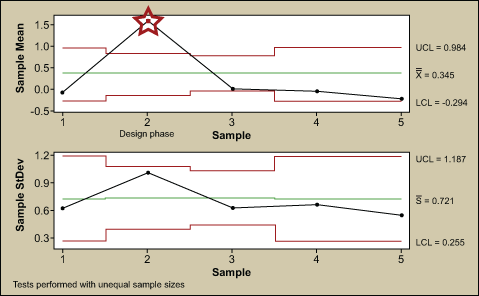
Conversely, the Xbar-S chart for Project B shows an abnormally low value of the CR (data point outside LCL) during the design phase (Figure 4). This suggests that project management was not efficient during that phase of the project and corrective action needs to be taken.

A Winning Combination
EVM can be used to monitor the progress of a project – any type of project including Lean Six Sigma improvement projects – in particular the use of the key measure of CR. But because the CR only provides a snapshot of performance at a given time, combining the use of a control chart with the CR allows project teams to monitor the variation of the CR over time and identify problems to solve or high points to capitalize on.
Additional Resources
- Bass, Issa, Six Sigma Statistics with Excel and Minitab, McGraw-Hill Professional, New York, 2007.
- Chambers, David S. and Wheeler, Donald J., Understanding Statistical Process Control, SPC Press, Tennessee, 1992.
- Heldman, Kim, PMP: Project Management Professional Study Guide, Sybex Inc., New Jersey, 2002.
