
Practitioners who think process mapping can be completed in a two-hour session with a group of subject matter experts, a white board and some sticky notes are likely to end up with a nice piece of paper with a bunch of squares and diamonds. This is because process mapping is not for wimps. Creating a process map that tells a full, data-based story requires a decent amount of time and effort by those individuals involved in the process.
Gathering Information
A great process map should show, with certainty, where improvements can be made, where cycle time delays exist and where smooth handoffs are not taking place. Creating a process, or value stream, map should be the first act a company performs when seeking to make process improvements. If they start more advanced process improvement methodologies without completing a value stream map first, organizations may make a slower start on their road to improvement. Of course, practitioners should not avoid these advanced methodologies. But they will benefit from beginning with a process map, which can make an immediate impact – immediate in the sense of less than three months.
Again, process mapping is not an easy undertaking. It is the perfect combination of business acumen and art. It takes special talent to interview individuals and get them to explain exactly what they do in their job every day, as well as share their pains and express their wants. In fact, it takes the ability to connect with many different types of people and personalities, the know-how to ask questions that will effectively prompt the interviewee and the listening skills to understand what a person is saying – without judgment or prejudice.
A skilled practitioner may ask some of the following questions during an interview to capture process owners’ pains and wants:
- What parts of the process do you seek to eliminate, and why?
- Where do you spend most of your time, and why?
- Where in the process do you repeat work? How often, and why?
- What does your manager think happens in the process? What really happens?
- When pressed for time, what steps in the process do you skip or work around?
But what about the data-based story component? Well, to perform a true value stream mapping exercise, data must be collected in conjunction and concurrently with the interviews. Questions to collect this data may include:
- Where do cycle time delays exist?
- Where do handoffs take place?
- Do people actually hand something off, or is it submitted to a system with the assumption that it is handed off?
- What data points are put into systems? What data points are taken out?
- What pains does the process cause? What do people want or desire from the process?
Gathering data is the real power of performing process mapping. The master plot, the final map with all the details, is great for showing people the process, but the juicy stuff is in the data that is collected.
Sample Process Map
The figure below is a picture of an end-to-end sales process; in real life it is eight feet long. The green boxes represent steps where cycle time delays exist. The yellow boxes are manual steps where automation can take place. The lines coming in and out of the circles (multiple systems) indicate data that comes in or out of a system.
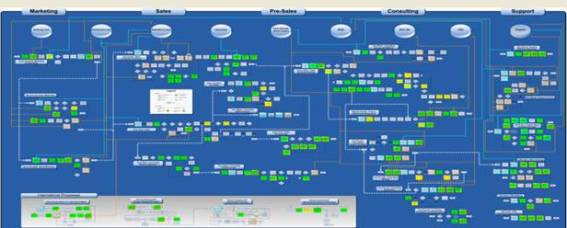
One of the practitioner’s challenges is to identify exactly how many handoffs there are in the process, and how many inputs go into a system but never get taken out. However, the absolute biggest benefit comes from taking steps out of the process. Once changes have been made, practitioners can calculate a return on investment and assign value to each step in the process.
Five Key Tips
The following are some tips and tricks for process mapping any process in an organization:
- Scope the process: Clearly define a start and stop in the process.
- Identify metrics of importance: To give the effort value, practitioners should determine what they want to eliminate from the process – process steps that generate cycle time, steps where individuals seek approvals, steps where individuals perform manual effort and so on. These will become the steps to color code as action items.
- Select a map collection method: Process mapping can be performed using sticky notes, a spreadsheet or technical drawing software program, or paper and pen. Practitioners should select the method that works best for them and their organization.
- Validate the process maps: After completing a first round of interviews, practitioners should have someone within the organization who is familiar with the process read the maps. This person should check for clarity, content and continuity. The practitioner can review the feedback with the original interviewee for confirmation.
- Minimal interviewees at one time: Practitioners should not attempt to create process maps with large groups. It is best to interview one or two people at a time, therefore reducing social conversation and the desire to correct the process during the mapping session.
