
While most of us are familiar with the concept of problem-solving, it is usually not particularly rigorous. TRIZ is a unique philosophy of problem solving that relies on logic, data, and prior research.
We will explore the underlying principles and tools to help you understand how to apply TRIZ to your organization’s problems. Although heavily based on engineering principles, you will see it has broad application and many benefits compared to typical problem-solving approaches.
Overview: What is TRIZ?
TRIZ is the acronym for the Russian phrase Teoriya Resheniya Izobreatatelskikh Zadatch. TRIZ was developed by Genrich Altshuller, a Russian scientist and engineer. He and some of his associates developed their theory of inventive problem-solving between the mid 1940s and mid 1980s.
TRIZ’s unique approach to problem-solving is based upon Altshuller’s realization that someone, somewhere, had already come up with a solution (or something close) for the problem you currently face. Creative problem-solving involves finding that solution and adapting it to your problem.
With that insight, Altshuller evolved his theory based on extensive research reviewing hundreds of thousands of inventions across many different fields. The solutions seemed to have a generalized pattern and a similarity of the problems being faced. TRIZ identifies and codifies these patterns into a set of principles to make the creative process more consistent and predictable. Altshuller found that almost every invention or innovation fell into one of 40 categories.
The two key concepts in TRIZ are developing general solutions for general problems and eliminating contradictions. This graphic provides a simple explanation of the TRIZ problem-solving approach.
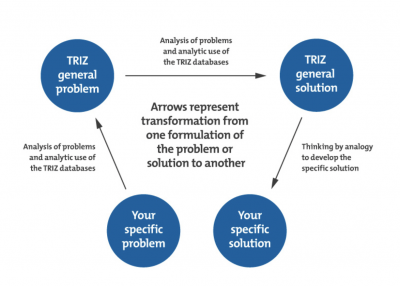
Image source: mindtools.com.
The TRIZ databases mentioned above include the TRIZ 40 Principles and 76 Standard Solutions. The 40 principles are a collection of ideas Altshuller believed were at the heart of all inventions. These would serve as a guide to help you develop the solution to your problem.
- Segmentation
- Taking out
- Local quality
- Asymmetry
- Merging
- Universality
- “Nested doll”
- Anti-weight
- Preliminary anti-action
- Preliminary action
- Beforehand cushioning
- Equipotentiality
- The other way around
- Spheroidality
- Dynamics
- Partial or excessive actions
- Another dimension
- Mechanical vibration
- Periodic action
- Continuity of useful action
- Skipping
- “Blessing in disguise”
- Feedback
- “Intermediary”
- Self-service
- Copying
- Cheap short-living
- Mechanics substitution
- Pneumatics and hydraulics
- Flexible shells and thin films
- Porous materials
- Color changes
- Homogeneity
- Discarding and recovering
- Parameter changes
- Phase transitions
- Thermal expansion
- Strong oxidants
- Inert atmosphere
- Composite material films
The 76 Standard Solutions are a set of solutions applicable to most common problems.
The second concept of TRIZ is contradiction. One of the challenges is that solutions often create a conflict or contradiction.
For example, your company wants to solve the problem of handling incoming customer calls. Your solution of implementing an automatic voice response system will reduce your labor cost. The contradiction is that it may create customer dissatisfaction of having to speak with a machine and delay the answer they want because of having to respond to all the voice prompts.
The TRIZ Contradiction Matrix will provide possible solutions for resolving that contradiction.
The use of TRIZ can be used to enhance your Six Sigma deployment by providing tools to supplement your DMAIC projects as well as DMADV projects.
2 benefits and 1 drawback of TRIZ
TRIZ is a sophisticated and structured approach to problem-solving. As such, there are a number of benefits — but also some important drawbacks.
1. You don’t need to reinvent the wheel
The underlying premise of TRIZ is that your problem has already been solved by someone, so your task is to discover what the solution was and apply it to your specific problem.
2. Quicker path to solution
By using TRIZ, your project team can come to a solution quicker. The TRIZ process is organized and structured so time is not wasted examining endless possible solutions, most of which are not feasible.
3. Based on engineering solutions
The 40 principles and 76 standard solutions of TRIZ were developed based on technical and engineering solutions. A drawback to TRIZ is the challenge of applying it to non-manufacturing problems and processes.
Why is TRIZ important to understand?
Thanks to the structure of TRIZ, you can narrow in on a solution to your problem in a methodical manner.
The approach is simple yet elegant
You start with a specific definition of your problem. Then you identify a similar general problem as defined by TRIZ. For that general problem, you identify a TRIZ general solution. Finally, you apply the general solution to your specific solution.
Contradictions are important
At the core of most problems are contradictions resulting from solutions.
You want your software to contain many functionalities, yet that can conflict with it being user-friendly. You want your Six Sigma training to be comprehensive, yet that will conflict with keeping people away from their jobs.
The resolution of these conflicts is the key to finding the perfect solution to your problem. The TRIZ Contradiction Matrix is one of the core tools for resolving these conflicts.
TRIZ does not inhibit innovation
You might be concerned that the use of TRIZ will hinder your innovation and creativity because it relies on a fixed set of principles and solutions. This is not the case, though. Your creativity will be used in adapting the generalized solution to your specific solution and solving any contradictions.
An industry example of TRIZ
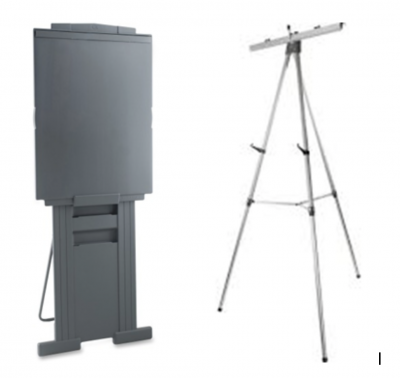
Six Sigma consultants doing client training often complain that the flip-chart easel stands they have to use are heavy and inconvenient to move and transport. One manufacturer of flip-chart easels was determined to solve that problem.
After reviewing the 40 TRIZ principles, they decided Number 7, Nested Dolls, might be the generalized problem of trying to transport many different size dolls. A Russian nesting doll has one doll inside of another, with another doll inside that one, and so on. The company’s current easel design was fixed with a heavy base.
By applying the Nested Doll solution, the company designed an easel with legs that telescope for use and then fold back up, so one part of the leg is inside the one above it. The construction was of light-grade aluminum. This solved the problem of space and transport. The contradiction is the stability of the lighter easel. A cross bar was designed to help stabilize the lighter stand.
Here is the before and after design:
3 best practices when thinking about TRIZ
Given the power of this tool, you will want to apply it carefully and judiciously to your problems.
1. Keep it simple
When explaining and presenting your TRIZ process and solutions, keep it simple so you don’t confuse your audience.
2. Adapt the 40 principles
If your organization is not engineering-oriented, you may have to adapt the language of the 40 principles to better fit your specific industry or company.
3. Use TRIZ as a guide rather than as an absolute
Don’t get hung up on the TRIZ tools as the absolute only way to solve your problem. If you are having difficulty finding a generalized problem or generalized solution, don’t get frustrated and quit. Adapt as needed, and keep the process moving using TRIZ as guidelines, not rules.
Frequently Asked Questions (FAQ) about TRIZ
What is TRIZ?
TRIZ is a structured approach to problem-solving based on the concept that every problem has already been solved by someone, somewhere, sometime in the past. By generalizing your problem and adapting generalized solutions, you can quickly come to a solution to your specific problem.
What are the TRIZ 40 principles?
The developer of TRIZ, Genrich Altshuller, concluded after reviewing thousands of patents that there was a pattern of problems and solutions inventors followed. He synthesized these into a set of 40 principles to be used as a guide for generalized problem definition and solution that could then be adapted to a specific problem and solution.
What is meant by TRIZ contradictions?
Every solution to a problem will create an alternative contradiction. If you decide to expand your product SKUs (stock keeping unit) to satisfy a broader market demand, your contradiction will be the added effort and cost of producing and inventorying the added number of products.
Will TRIZ solve your problem?
If you have a problem your standard Six Sigma tools can’t solve, TRIZ might be the tool for you. Follow these simple steps:
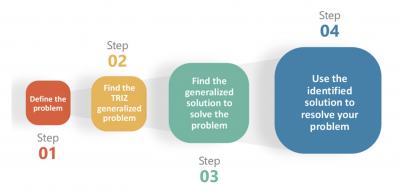
Image source: Slidemodel.com.
Use the 40 Principles, 76 Standard Solutions, and the Contradiction Matrix to move from your specific problem to specific solution.

