
Many consultants remember the hypothesis testing roadmap, which was a great template for deciding what type of test to perform. However, think about the type of data one gets. What if there is only summarized data? How can that data be used to make conclusions? Having the raw data is the best case scenario, but if it is not available, there are still tests that can be performed.
In order to not only look at data, but also interpret it, consultants need to understand distributions. This article discusses how to:
- Understand different types of statistical distributions.
- Understand the uses of different distributions.
- Make assumptions given a known distribution.
Six Sigma Green Belts receive training focused on shape, center and spread. The concept of shape, however, is limited to just the normal distribution for continuous data. This article will expand upon the notion of shape, described by the distribution (for both the population and sample).
Getting Back to the Basics
With probability, statements are made about the chances that certain outcomes will occur, based on an assumed model. With statistics, observed data is used to determine a model that describes this data. This model relates to the distribution of the data. Statistics moves from the sample to the population while probability moves from the population to the sample.
Inferential statistics is the science of describing population parameters based on sample data. Inferential statistics can be used to:
- Establish a process capability (determine defects per million).
- Utilize distributions to estimate the probability of a variable occurring given known parameters.
Inferential statistics are based on a normal distribution.
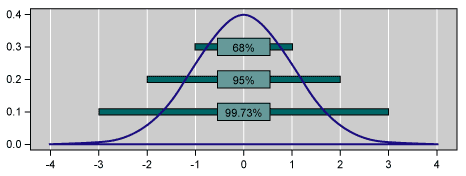
Normal curve distribution can be expanded on to learn about other distributions. The appropriate distribution can be assigned based on an understanding of the process being studied in conjunction with the type of data being collected and the dispersion or shape of the distribution. It can assist with determining the best analysis to perform.
Types of Distributions
Distributions are classified in the same ways as data is classified – continuous and discrete:
- Continuous probability distributions are probabilities associated with random variables that are able to assume any of an infinite number of values along an interval.
- Discrete probability distributions are listings of all possible outcomes of an experiment, along with their respective probabilities of occurrence.
Distribution Descriptions
Probability mass function (pmf) – For discrete variables, the pmf is the probability that a variate takes the value x.
Probability density function (pdf) – For continuous variables, the pdf is the probability that a variate assumes the value x, expressed in terms of an integral between two points.
In the continuous sense, one cannot give a probability of a specific x on a continuum – it will be some specific (and small) range. For additional insight, think of x + Dx where Dx is small.
The notation for the pdf is f(x). For discrete distributions:
f(x) = P(X = x)
Some refer to this as the probability mass function, since it is evaluating the probability upon that one discrete mass. For continuous distributions, one mass cannot be established.
Cumulative density function (cdf) – The probability that a variable takes a value less than or equal to x.
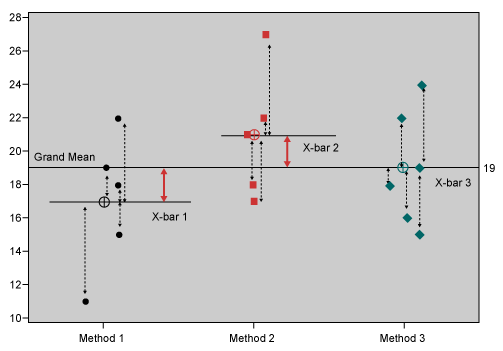
Cdf progresses to a value of 1 because there cannot be a probability greater than 1. Once again, cdf is F(x) = P(X < x).This holds for both continuous and discrete.
Parameters
Parameter is a population description. Consultants rely on parameters to characterize the distributions. There are three parameters:
- Location parameter – the lower or midpoint (as prescribed by the distribution) of the range of the variate (think of the mean)
- Scale parameter – determines the scale of measurement for x (magnitude of the x-axis scale) (think of the standard deviation)
- Shape parameter – defines the pdf shape within a family of shapes
Not all distributions have all the parameters. For example, the normal distribution parameters have just the mean and standard deviation. Just those two need to be known to describe a normal population.
Summary of Distributions
The remaining portion of this article will summarize the various shapes, basic assumptions and uses of distributions. Keep in mind that there is a different pdf and different distribution parameters associated with each.
Normal Distribution (Gaussian Distribution)
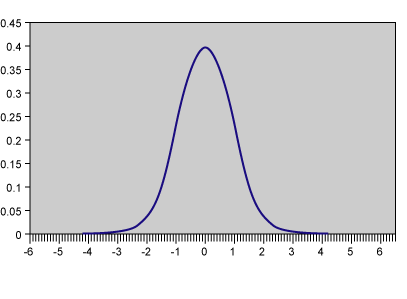
Basic assumptions:
- Symmetrical distribution about the mean (bell-shaped curve)
- Commonly used in inferential statistics
- Family of distributions characterized is by m and s
Uses include:
- Probabilistic assessments of distribution of time between independent events occurring at a constant rate
- Mean is the inverse of the Poisson distribution
- Shape can be used to describe failure rates that are constant as a function of usage
Exponential Distribution
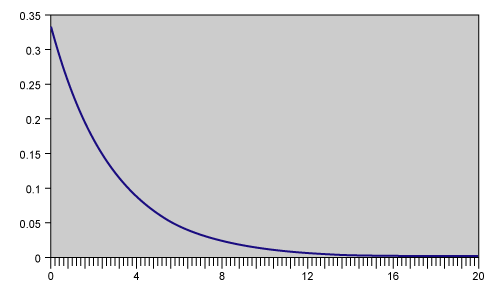
Basic assumptions:
- Family of distributions characterized by its m
- Distribution of time between independent events occurring at a constant rate
- Mean is the inverse of the Poisson distribution
- Shape can be used to describe failure rates that are constant as a function of usage
Uses include probabilistic assessments of:
- Mean time between failure (MTBF)
- Arrival times
- Time, distance or space between occurrences of the events of interest
- Queuing or wait-line theories
Lognormal Distribution
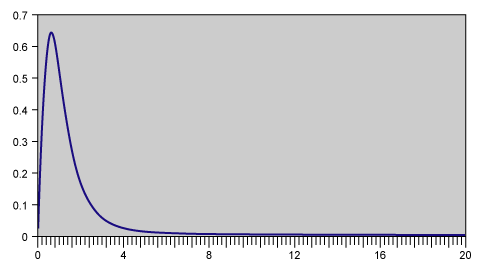
Basic assumptions:
Asymmetrical and positively skewed distribution that is constrained by zero.
- Distribution can exhibit many pdf shapes
- Describes data that has a large range of values
- Can be characterized by m and s
Uses include simulations of:
- Distribution of wealth
- Machine downtimes
- Duration of time
- Phenomenon that has a positive skew (tails to the right)
Weibull Distribution
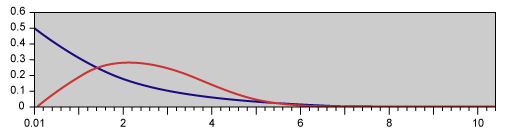
Basic assumptions:
- Family of distributions
- Can be used to describe many types of data
- Fits many common distributions (normal, exponential and lognormal)
- The differing factors are the scale and shape parameters
Uses include:
- Lifetime distributions
- Reliability applications
- Failure probabilities that vary over time
- Can describe burn-in, random, and wear-out phases of a life cycle (bathtub curve)
Binomial Distribution
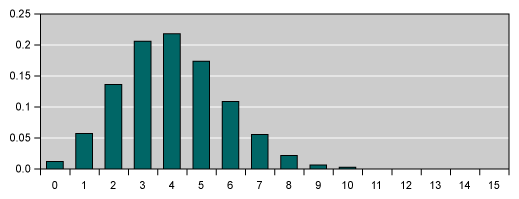
Basic assumptions:
- Discrete distribution
- Number of trials are fixed in advance
- Just two outcomes for each trial
- Trials are independent
- All trials have the same probability of occurrence
Uses include:
- Estimating the probabilities of an outcome in any set of success or failure trials
- Sampling for attributes (acceptance sampling)
- Number of defective items in a batch size of n
- Number of items in a batch
- Number of items demanded from an inventory
Geometric
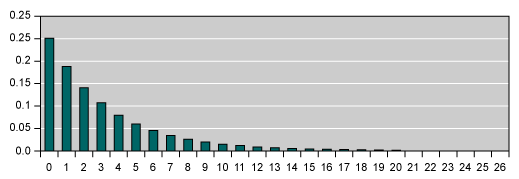
Basic assumptions:
- Discrete distribution
- Just two outcomes for each trial
- Trials are independent
- All trials have the same probability of occurrence
- Waiting time until the first occurrence
Uses include:
- Number of failures before the first success in a sequence of trials with probability of success p for each trial
- Number of items inspected before finding the first defective item – for example, the number of interviews performed before finding the first acceptable candidate
Negative Binomial
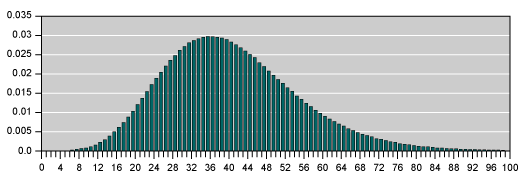
Basic assumptions:
- Discrete distribution
- Predetermined number of occurrences – s
- Just two outcomes for each trial
- Trials are independent
- All trials have the same probability of occurrence
Uses include:
- Number of failures before the sth success in a sequence of trials with probability of success p for each trial
- Number of good items inspected before finding the sth defective item
Poisson Distribution
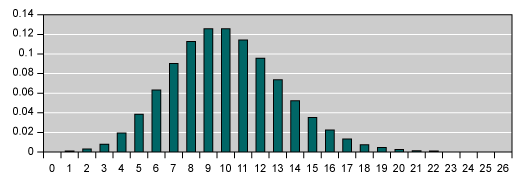
Basic assumptions:
- Discrete distribution
- Length of the observation period (or area) is fixed in advance
- Events occurs at a constant average rate
- Occurrences are independent
- Rare event
Uses include:
- Number of events in an interval of time (or area) when the events are occurring at a constant rate
- Number of items in a batch of random size
- Design reliability tests where the failure rate is considered to be constant as a function of usage
Hypergeometric
Shape is similar to Binomial/Poisson distribution.
Basic assumptions:
- Discrete distribution
- Number of trials are fixed in advance
- Just two outcomes for each trial
- Trials are independent
- Sampling without replacement
- This is an exact distribution – the Binomial and Poisson are approximations to this
Other Distributions
There are other distributions – for example, sampling distributions and X2, t and F distributions.
Summary
Distribution refers to the behavior of a process described by plotting the number of times a variable displays a specific value or range of values rather than by plotting the value itself. It is often said that a picture is worth a thousand words. Viewing data graphically will make a much greater impact to an audience. Becoming familiar with the various distributions can help consultants to better interpret their data.
