
Key Points
- A DOE is a great way of analyzing the relationship between factors.
- You can control inputs in a well-designed DOE.
- Understanding the basic principles of DOE is fundamental for anyone conducting analysis.
Design of experiments (DOE) is a systematic method to determine the relationship between factors affecting a process and the output of that process. In other words, it is used to find cause-and-effect relationships. This information is needed to manage process inputs in order to optimize the output.
An understanding of DOE first requires knowledge of some statistical tools and experimentation concepts. Although a DOE can be analyzed in many software programs, it is important for practitioners to understand basic DOE concepts for proper application.
Common DOE Terms and Concepts
The most commonly used terms in the DOE methodology include controllable and uncontrollable input factors, responses, hypothesis testing, blocking, replication, and interaction.
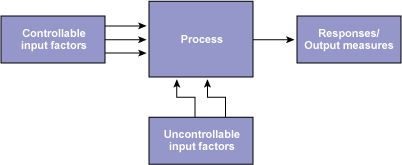
- Controllable input factors, or x factors, are those input parameters that can be modified in an experiment or process. For example, in cooking rice, these factors include the quantity and quality of the rice and the quantity of water used for boiling.
- Uncontrollable input factors are those parameters that cannot be changed. In the rice-cooking example, this may be the temperature in the kitchen. These factors need to be recognized to understand how they may affect the response.
- Responses, or output measures, are the elements of the process outcome that gauge the desired effect. In the cooking example, the taste and texture of the rice are the responses.
The controllable input factors can be modified to optimize the output. The relationship between the factors and responses is shown in Figure 1.
- Hypothesis testing helps determine the significant factors using statistical methods. There are two possibilities in a hypothesis statement: the null and the alternative. The null hypothesis is valid if the status quo is true. The alternative hypothesis is true if the status quo is not valid. Testing is done at a level of significance, which is based on probability.
- Blocking and replication: Blocking is an experimental technique to avoid any unwanted variations in the input or experimental process. For example, an experiment may be conducted with the same equipment to avoid any equipment variations. Practitioners also replicate experiments, performing the same combination run more than once, in order to get an estimate for the amount of random error that could be part of the process.
- Interaction: When an experiment has three or more variables, an interaction is a situation in which the simultaneous influence of two variables on a third is not additive.
Why Should You Conduct a DOE?
A design of experiments might seem superfluous, especially for companies just starting. However, they are a heavily used tool in many industries because of their flexibility. You have full control over how variables can ways the output of a test. Further, it might enable you to see where a problem is arising in your production output.
A Simple One-factor Experiment
The comparison of two or more levels in a factor can be done using an F-test. This compares the variance of the means of different factor levels with the individual variances, using this equation:
F = ns2Y-bar / s2pooled
where:
n = the sample size
s2Y-bar = the variance of the means, which is calculated by dividing the sum of variances of the individual means by the degrees of freedom
s2pooled = pooled variance, or the average of the individual variances
This is similar to the signal-to-noise ratio used in electronics. If the value of F (the test statistic) is greater than the F-critical value, it means there is a significant difference between the levels, or one level is giving a response that is different from the others. Caution is also needed to ensure that s2pooled is kept to a minimum, as it is the noise or error term. If the F value is high, the probability (p-value) will fall below 0.05, indicating that there is a significant difference between levels. The value of 0.05 is a typical accepted risk value.
If F = 1, it means the factor has no effect.
As an example of a one-factor experiment, data from an incoming shipment of a product is given in Table 1.
Table 1: Incoming Shipment Data
| Lot | Data |
| A | 61, 61, 57, 56, 60, 52, 62, 59, 62, 67, 55, 56, 52, 60, 59, 59, 60, 59, 49, 42, 55, 67, 53, 66, 60 |
| B | 56, 56, 61, 67, 58, 63, 56, 60, 55, 46, 62, 65, 63, 59, 60, 60, 59, 60, 65, 65, 62, 51, 62, 52, 58 |
| C | 62, 62, 72, 63, 51, 65, 62, 59, 62, 63, 68, 64, 67, 60, 59, 59, 61, 58, 65, 64, 70, 63, 68, 62, 61 |
| D | 70, 70, 50, 68, 71, 65, 70, 73, 70, 69, 64, 68, 65, 72, 73, 75, 72, 75, 64, 69, 60, 68, 66, 69, 72 |
When a practitioner completes an analysis of variance (ANOVA), the following results are obtained:
Table 2: ANOVA Summary
| Groups | Count | Sum | Average | Variance | ||
| A | 25 | 1,449 | 57.96 | 31.54 | ||
| B | 25 | 1,483 | 59.32 | 23.14333 | ||
| C | 25 | 1,570 | 62.80 | 18.5 | ||
| D | 25 | 1,708 | 68.32 | 27.64333 | ||
| ANOVA | ||||||
| Source of Variation | SS | df | MS | F | p-value | F-crit |
| Between groups | 1,601.16 | 3 | 533.72 | 21.17376 | 1.31 x 10⁻¹⁰ | 2.699394 |
| Within groups | 2,419.84 | 96 | 25.20667 | |||
| Total | 4,021 | 99 |
Statistical software can provide hypothesis testing and give the actual value of F. If the value is below the critical F value, a value based on the accepted risk, then the null hypothesis is not rejected. Otherwise, the null hypothesis is rejected to confirm that there is a relationship between the factor and the response. Table 2 shows that the F is high, so there is a significant variation in the data. The practitioner can conclude that there is a difference in the lot means.
Two-level Factorial Design
This is the most important design for experimentation. It is used in most experiments because it is simple, versatile, and can be used for many factors. In this design, the factors are varied at two levels – low and high.
Two-level designs have many advantages. Two are:
- The size of the experiment is much smaller than other designs.
- The interactions of the factors can be detected.
For an example of a two-level factorial design, consider the cake-baking process. Three factors are studied: the brand of flour, the temperature of baking, and the baking time. The associated lows and highs of these factors are listed in Table 3.
Table 3: Cake-baking Factors and Their Associated Levels
| Factor | Name | Units | Low Level (-) | High Level (+) |
| A | Flour brand | Cost | Cheap | Costly |
| B | Time | Minutes | 10 | 15 |
| C | Temperature | Degrees (C) | 70 | 80 |
The output responses considered are “taste” and “crust formation.” Taste was determined by a panel of experts, who rated the cake on a scale of 1 (worst) to 10 (best). The ratings were averaged and multiplied by 10. Crust formation is measured by the weight of the crust, the lower the better.
The experiment design, with the responses, is shown in Table 4.
Table 4: Settings of Input Factors and the Resulting Responses
| Run Order | A: Brand | B: Time (min) | C: Temp. (C) | Y1: Taste (rating) | Y2: Crust (grams) |
| 1 | Costly(+) | 10(-) | 70(-) | 75 | 0.3 |
| 2 | Cheap(-) | 15(+) | 70(-) | 71 | 0.7 |
| 3 | Cheap(-) | 10(-) | 80(+) | 81 | 1.2 |
| 4 | Costly(+) | 15(+) | 70(-) | 80 | 0.7 |
| 5 | Costly(+) | 10(-) | 80(+) | 77 | 0.9 |
| 6 | Costly(+) | 15(+) | 80(+) | 32 | 0.3 |
| 7 | Cheap(-) | 15(+) | 80(+) | 42 | 0.5 |
| 8 | Cheap(-) | 10(-) | 70(-) | 74 | 3.1 |
Analysis of the results is shown in Table 5. Figures 2 through 4 show the average taste scores for each factor as it changes from low to high levels. Figures 5 through 7 are interaction plots; they show the effect of the combined manipulation of the factors.
Table 5: ANOVA Table for the Taste Response
| Factor | df | SS | MS | F | Effect | Contrast | p | F-crit at 1% |
| Brand | 1 | 2.0 | 2.0 | 0.0816 | -1 | -4.00 | 0.82 | 16.47 |
| Time | 1 | 840.5 | 840.5 | 34.306 | -20.5 | -82.00 | 0.11 | |
| Brand x time | 1 | 0.5 | 0.5 | 0.0204 | 0.5 | 2.00 | 0.91 | |
| Temp | 1 | 578.0 | 578.0 | 23.592 | -17 | -68.00 | 0.13 | |
| Brand x temp | 1 | 72.0 | 72.0 | 2.9388 | -6 | -24.00 | 0.34 | |
| Time x temp | 1 | 924.5 | 924.5 | 37.735 | -21.5 | -86.00 | 0.10 | |
| Brand x time x temp | 1 | 24.5 | 24.5 | 1 | -3.5 | -14.00 | 0.50 | |
| Error | 1 | 24.5 | 24.5 | |||||
| Total | 7 | 2442.0 |
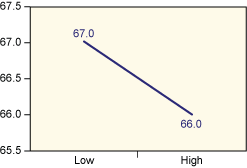
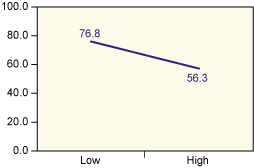
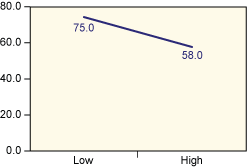
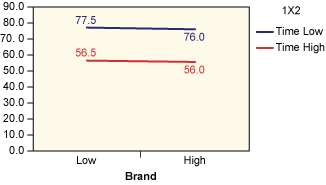
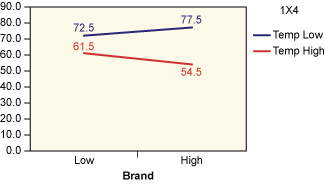
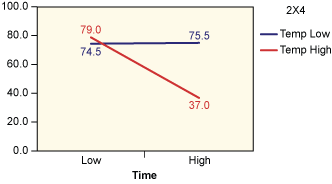
From reading an F table, the critical F value at 1 percent is 16.47. As the actual value of F for time and temperature exceed this value (time is at 34.306 and temperature is 23.592), it’s possible to conclude that both of them have a significant effect on the taste of the product. This is also evident from Figures 3 and 4, where the line is steep for the variation of these two factors. Figure 7 also shows that when the temperature is high, the taste sharply decreases with time (as charring takes place).
For the crust formation, the data analysis is shown in Table 6.
Table 6: ANOVA Table for the Crust Response
| Factor | df | SS | MS | F | Effect | Contrast | F-crit at 1% |
| Brand | 1 | 1.4 | 1.4 | 1.4938 | -0.825 | -3.30 | 16.47 |
| Time | 1 | 1.4 | 1.4 | 1.4938 | -0.825 | -3.30 | |
| Brand x time | 1 | 1.1 | 1.1 | 1.1536 | 0.725 | 2.90 | |
| Temp | 1 | 0.5 | 0.5 | 0.4952 | -0.475 | -1.90 | |
| Brand x temp | 1 | 0.7 | 0.7 | 0.7257 | 0.575 | 2.30 | |
| Time x temp | 1 | 0.1 | 0.1 | 0.0672 | 0.175 | 0.70 | |
| Brand x time x temp | 1 | 0.9 | 0.9 | 1 | -0.675 | -2.70 | |
| Error | 1 | 0.9 | 0.9 | ||||
| Total | 7 | 5.9 |
In this case, the actual F value for the three factors (brand, time, and temperature) is below the critical F value for 1 percent (16.47). This shows that these are not significant factors for the crust formation in the cake. If further optimization of the crust formation is needed, then other factors, such as the quantity of ingredients in the cake (eggs, sugar, and so on), should be checked.
Other Useful Tools and Concepts
Looking for some other ways to bolster your DOE? Understanding how to work within a fractional factorial DOE can save time and money to properly implement.
Additionally, learning how to account for replicates in your test can increase the accuracy of your tests. Our guide on the subject covers how they work and where to implement them.
Versatile Tool for Practitioners
The design of experiments is a powerful tool in Six Sigma to manage the significant input factors to optimize the desired output. Factorial experiments are versatile because many factors can be modified and studied at once. The following resources can help learn more about DOEs:
- DOE Simplified Practical Tools for Effective Experimentation (Productivity Inc., 2000)
- Design and Analysis of Experiments (John Wiley and Sons, 1997)
