
The quality of a product or service is a key element in creating customer satisfaction. The level of satisfaction is ultimately dependent on the fulfilment of customer needs. The Kano survey is a valuable tool for capturing the voice of the customer (VOC), providing critical information on the importance of products and services and the level of satisfaction from the customer’s perspective. Quality function deployment (QFD) is an important tool in translating VOC into product specifications. It is the only comprehensive quality tool aimed specifically at translating and comparing customer satisfaction measures.
Used in combination, the Kano survey and QFD tools provide companies with the ability to maximize customer satisfaction (positive quality) measured by metrics such as repeat business and market share. There are significant benefits in using the Kano method to capture client perception and the QFD model to understand the relationship between product features and customer satisfaction.
An example illustrates how the use of Kano and QFD improved a corporate quality function help desk.
The corporate quality function help desk is an intranet-based help desk tool used extensively by process improvement practitioners. The effectiveness of the help desk is measured against service-level agreements established by the help desk administrators. A turnaround time (TAT) metric was adopted for gauging internal customer satisfaction with the help desk. However, in spite of highly favorable TAT results, various qualitative comments captured in customer surveys indicated dissatisfaction. As a result, administrators of the help desk (referred to as the QDI help desk) needed to find an effective way to collect the exact requirements of customers and to identify an appropriate solution.
Kano Model and Kano Survey
The Kano model classifies product attributes based on how they are perceived by customers as well as the effect of the attributes on customer satisfaction. Since the impact on customer satisfaction is different for each customer requirement, it is important to determine which attributes of a product or service bring more satisfaction than others. The Kano classifications used to capture this information identify which attributes drive customer satisfaction, and indicate where a company should focus to retain market competitiveness. Meeting the customers’ basic quality needs provides the foundation for the elimination of dissatisfaction and complaints. Exceeding expectation creates a competitive advantage and leads to innovation.
In the example, a Kano questionnaire was designed to understand customer requirements and identify opportunities to improve the service provided by the help desk. First, key services offered through the help desk were analyzed to create a list of inputs for the questionnaire. These included:
- Response time
- Quality of reply
- Ease of use of the tool
- Relevance of the help desk in projects
- Clarity of communication
- Usefulness of the help desk-FAQ function
- Help desk discussion forum usage
- Usefulness of user manual
- Help desk facility value to software projects
The questionnaire design captured VOC relative to the importance of individual help desk services, current satisfaction level and ratings compared to other help desks used by the customer.
Collecting the Voice of the Customer
To capture VOC for the help desk, customers were asked to provide qualitative inputs on improving help desk performance and also rate each of the help desk features or attributes using the scale below.
- 0 – Not used
- 1 – Not useful
- 2 – Useful to some extent
- 3 – Satisfactory
- 4 – Good
- 5 – Excellent
The survey sample targeted customers who utilized the help desk within the last three months and included a sample size of 10 percent to 20 percent of the total user community.
The Kano survey model measured customer perception of importance and satisfaction for specific help desk attributes. The attributes are classified in the following categories and plotted on the Kano importance/satisfaction grid (Figure 1):
- Threshold/Basic attributes: Characteristics that must exist in order for the product to achieve success. The customer can remain neutral in attitude toward the product even with improved execution of the attributes.
- One-dimensional attributes (performance/linear): Characteristics that directly correlate to customer satisfaction. Increased functionality or quality of execution will result in increased customer satisfaction. Conversely, decreased functionality will result in greater dissatisfaction.
- Attractive attributes (exciters/delighters): Characteristics that give customers greater satisfaction and for which they are willing to pay a price premium. Satisfaction will not decrease below neutral if the product lacks the feature.
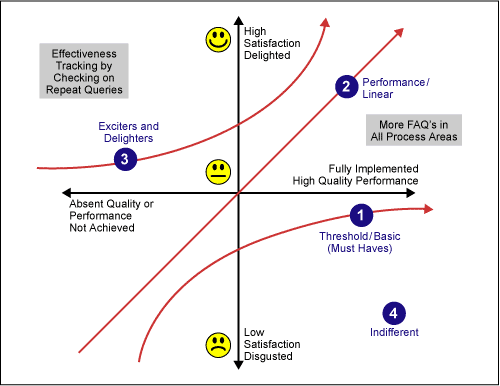
Information collected through the Kano survey is analyzed to uncover specific response types. Indifferent responses represent attributes the customer generally ignores. If the attributes are present, the customer is generally satisfied. If they are not present, there is no impact on customer satisfaction. Questionable responses and reversals are client perceptions that contradict each other.
Stratification of Responses
To understand the VOC received through the Kano survey, an analysis of the information is required. Responses are interpreted using the following process:
Step 1: Obtain the importance of each feature by stratifying the responses into three categories:
- Percentage of responses with rating above 3
- Percentage of responses with rating equal to 3
- Percentage of responses with rating less than 3
Step 2: Match the importance data against each feature and determine a ranking from a scale of 1 to 10, where 10 is the highest rank. For example, importance data obtained for the help desk response time attribute reflected that 89.5 percent of users rated the feature above 4 on the scale of 1 to 5. Since this attribute received the highest percentage importance rating as compared to the other attributes, it was given a ranking of 10.
Step 3: Review the ranking for all features to identify metrics that are important for measuring customer critical-to-quality elements (CTQs).
| Correlation Between VOC and CTQ Data | |
|
Correlation |
Rating |
| High |
9 |
| Medium |
6 |
| Low |
3 |
Step 4: Define the degree of correlation between the VOC and the CTQ data to identify relational measures.
Step 5: Review the relationship between individual metrics and eliminate any duplicate or irrelevant metrics.
Step 6: Perform a benchmark analysis using the competitive evaluation rating from the Kano questionnaire. The VOC data in the help desk example was used to compare customer perception of the corporate quality help desk to other help desk facilities used by customers participating in the survey.
Use of QFD for Help Desk Improvement
Once the VOC data was in-hand, the QFD tool, which many industries use to translate customer requirements to meaningful critical-to-quality attributes, was used to convert the VOC responses into technical requirements for the help desk.
The first level QFD/ first house of quality: The first step in developing the QFD is to consolidate and analyze customer responses and requirements. The requirements are segregated into categories based on the Kano survey model. The Kano survey results are used to create the first house of quality within the QFD tool (Figure 2).

Based on the first level QFD, the top five metrics are:
- Reply quality rating
- Query turnaround time
- Percentage repetitive queries
- Discussion forum turnaround time
- Hits on FAQs versus the number of queries received
The existing help desk processes were studied to determine the changes necessary to implement these metrics and a second house of quality was created (Figure 3).

The second level QFD: Enabling the help desk to select the following features for implementation:
- Feedback for the quality of reply.
- Monthly data processing with analysis for repetitive queries.
- Auto reminder mail to be sent from help desk for queries posted.
- Monthly analysis of the metrics: Hits on FAQs versus number of queries.
The QFD results provided an understanding of customer priorities, customer perceptions and the metrics necessary to ensure that customer requirements are addressed. The composite metrics resulting from the QFD are reflected in Figure 4.

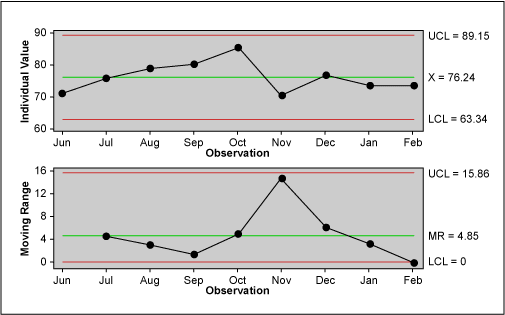
As a result of the QFD process, the help desk implemented a number of enhancements to address customer-specified requirements. The help desk administrators monitor the composite metrics with the help of individual and moving range (I-MR) control charts allowing them to identify assignable causes quickly and effectively (Figure 5).
Conclusion: Value in Kano and QFD
The Kano survey is an effective method of capturing customer perception. It provides Six Sigma practitioners with the ability to thoroughly analyze VOC data and identify specific metrics useful in understanding which product or service features are most important to customers and offer the best opportunity to increase customer satisfaction.
QFD is different from traditional quality tools, which target minimizing negative quality such as defects or poor service. With those systems, the best result, zero defects, will not necessarily ensure competitiveness in a market where customers have other defect-free choices. In addition to helping to reduce defects, the QFD process provides companies with a tool to maximize positive quality such as ease of use or luxury. Positive quality offers a link to achieving the delight factor addressed through the Kano model. Repeating the QFD exercise regularly allows companies to continually address the changing needs of customers.
