
© Ground Picture/Shutterstock.com
Key Points
- Building a culture around Kaizen requires commitment and leadership buy-in.
- Employees are empowered and capable of solving small problems with ease through regular practice of Kaizen.
- Small, incremental changes add up over time, leading to a compound effect that benefits your organization.
Organizational culture is the very foundation of your services, goods, and other outputs. As such, embracing a culture that prides itself on continuous improvement isn’t just a good idea, but a vital one. These are rarely something that springs up naturally as you build a business, but something that has to be encouraged and nurtured when looking at everyone from your frontline employees to the highest levels of management.
Taking the time to build a Kaizen culture is one of the best things you can do for your business. This isn’t just a set of tools or procedures, but rather a mindset. It is a mindset that empowers employees and helps to develop problem-solving skills, low-cost solutions, and more regularly. With that in mind, let’s take a look at how you can foster a Kaizen culture that will continue to thrive.
Core Principles and Practices

©Ground Picture/Shutterstock.com
Vision
Kaizen isn’t something that you can foist off on your employees and expect them to succeed. For any initiative like building a Kaizen culture to succeed, it needs to be championed from the very top. Your senior management should be front and center with visible support of the philosophy, alongside providing resources and time to employees. Let’s make something clear: this isn’t an occasion where the top brass can give speeches and expect everything to go smoothly.
For the best chances at building a Kaizen culture, your senior leadership isn’t just talking the talk, but putting those plans into action. Your vision of a Kaizen culture should be unified and organization-wide. Like any of the methodologies and philosophies we champion, these are meant to transform organizations on the whole.
Empowerment
Kaizen‘s true utility isn’t just in the practice of continually improving processes. Instead, it comes from the collective power and intelligence of your workforce. By providing the means to succeed, you’re enabling your output to transform for the better. To this end, you want to create a means for your employees to provide open feedback, submit improvement ideas, and encourage communication.
You want to create a blameless culture, as it were, where problems aren’t seen as shortcomings or means for discipline, but an opportunity for growth and improvement.
Incremental Changes
Kaizen isn’t about the big sweeping changes of an approach like business process reengineering. Instead, you’re making small, incremental changes. These micro-changes are less disruptive and far easier to enact than any large-scale overhauls. Further, the cumulative effect of these hundreds of small improvements will have a profound impact on daily operations. You won’t notice it at first, but in the course of building a Kaizen culture, you’ll likely see the compound effects of your improvement efforts over time.
Focus on Processes, Not People
Kaizen isn’t built around the notion that people are the problem. Problematic processes are usually the source of most woes, and improving those is your focus. Touching back on the notion of a blameless culture, this invites open discussion and feedback on the current conditions of processes. Your overarching goal isn’t to eliminate staff, but rather to eliminate the wastes and inefficiencies found in your processes. These can be things like time, effort, and resources.
PDCA
A common framework for implementing Kaizen, and something you’ll see done at Kaizen events, is the use of the Deming cycle, or PDCA cycle. This is a straightforward framework, which is relatively easy to follow. It works as follows:
Plan: Identify a problem, and create a small plan to address it.
Do: Implement the plan.
Check: Measure the results and see if the change worked as you intended.
Act: If the change was successful, standardize it and make it routine. If it didn’t work, go back to the drawing board and try again.
These four basic steps set the foundation for a continuous loop of learning and improvement.
Make It a Habit
The most important thing you can do, besides making use of the other strategies we’ve discussed, is to make Kaizen a daily habit. Building a Kaizen culture isn’t just about the occasional one-time Kaizen event. Instead, you can encourage and foster this growth by making it part of the daily routine of your regular operations. Taking just five minutes a day for a meeting to review performance, discuss improvements, or identify problems is practicing Kaizen. These regular little stand-up meetings keep the focus on improvement and help to reinforce the mindset.
5S
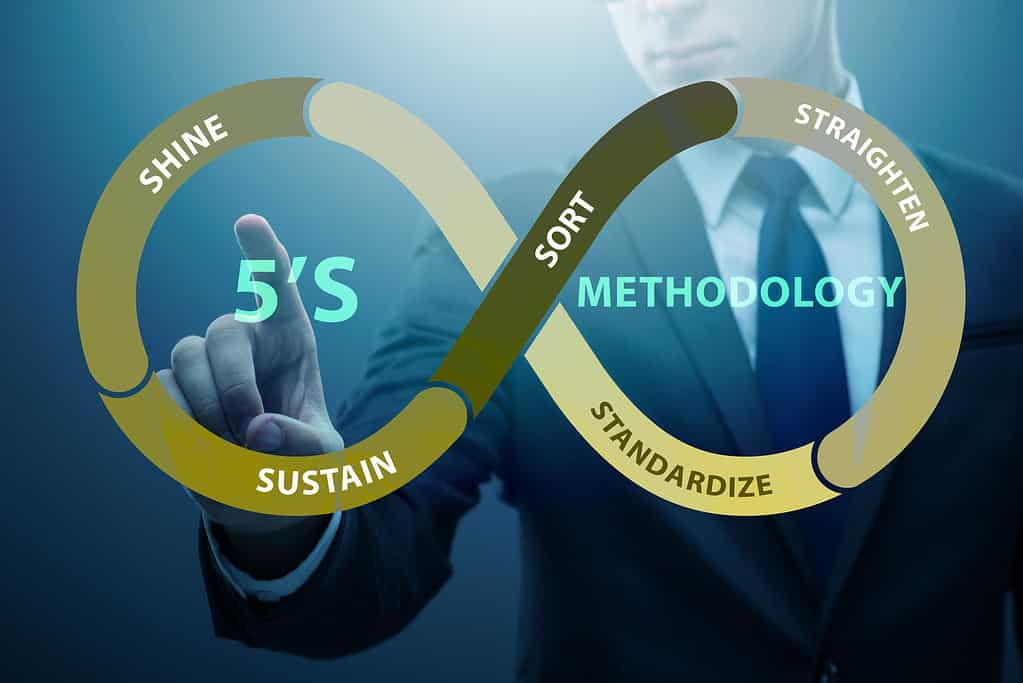
The 5S methodology is a fundamental part of Kaizen, and something your team is likely to use regularly. As such, taking the time to familiarize yourself with it, how it works, and how it benefits your organization is crucial for future success. We’ve got dedicated pieces on the effective use of 5S, so this is only a brief refresher and introduction.
Seiri
Seiri, or Sort, is conducted by going through your workspaces, offices, manufacturing floors, or what have you, and separating the necessary items from the unnecessary ones. You might conduct this as a red tagging event, where unnecessary items are flagged for removal. The goal is to only leave what is essential for the work to be done.
Seiton
After you’ve sorted through the clutter, it’s time to Seiton, or set in order. Organizing the remaining items in your workspace is vital for efficiency. Color-coding them can help, but the core thought behind this step is to make sure everything has a place and that everything is in its place.
Seiso
Organizing only goes so far when it comes to creating an orderly workspace. As such, you’ll want to shine, or Seiso, which is just cleaning. This is a daily practice where you go through and look for things that are out of place, rooting out potential problems and things that are out of the ordinary.
Seiketsu
So, how do you stop yourself from falling back into old habits? You commit to Seiketsu, or standardization. This is essentially formalizing and codifying the previous three steps. You might create simple guidelines, new standard operating procedures for sorting, and so forth. Teams should collaborate to determine what works and what doesn’t for this practice. Ideally, you’re looking to apply everything gained in the first three steps across the board for every department.
Shitsuke
The most difficult, and most important step of this entire cycle, is Shitsuke, or sustain. You want to make this a habit, something that is part of the fabric of your Kaizen culture. It isn’t about finding fault when conducting future audits, but sticking to good habits and looking for areas of improvement.
Other Useful Tools and Concepts
Ready to keep going? You might want to take a closer look at how Lean vs. Agile stack up when considering manufacturing. Lean is one of the driving forces behind modern manufacturing, but Agile is capable of great things outside of software development.
Additionally, you might want to look at how the Theory of Constraints and Lean stack up against each other. While both of these approaches have some overlap, you’re unlocking a powerful combination when using them together. Learning how to manage inefficiencies and reach breakthroughs is a fundamental part of refining any process.
Conclusion
Building a Kaizen culture isn’t something that is done overnight. It takes focus, commitment, and leadership buy-in to truly get off the ground. However, by taking some of the steps and implementing tools like 5S and PDCA in your workflow, you’re well on your way to making a culture centered around continuous improvement.
