
© Pixel-Shot/Shutterstock.com
In Six Sigma, we’re often taught that variation is the enemy. We apply a deeply analytical lens toward complex projects to seek out wastes, excesses, and bring them back under heel. When applied to a complex workload like software development, the most feared and hated sort of variation you’ll come across is scope creep. It can be tempting to add new features, but you’ll eventually see a modest budget for a $300,000 minimum viable product balloon into a $1.5 million behemoth if left unchecked.
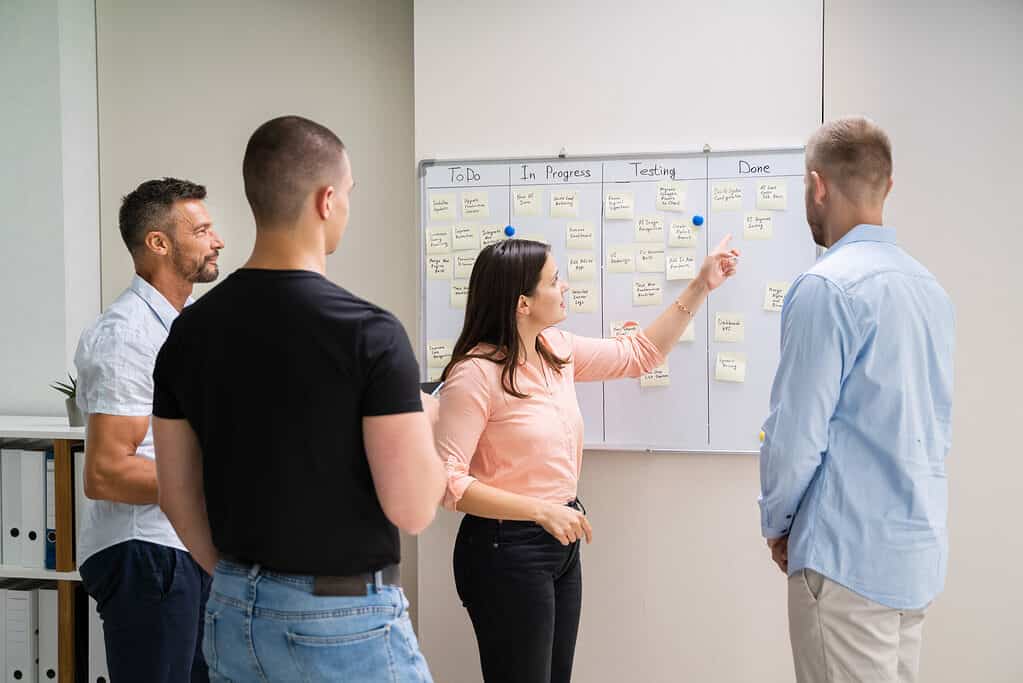
When you’re staring down the barrel of a potentially expensive project, you want to make the switch to Agile builds. These allow you to maintain the same level of discipline you might expect from a project fully utilizing Six Sigma, while operating in a nimble, iterative environment. It has additional benefits across the board, which we’ll explore in depth.
From Fixed Scope to Fixed Capacity

In a traditional project, you’re keeping track of time and cost, which helps to define the scope. With Agile Builds, you’re flipping this notion on its head. The fixed aspects of your project are going to be the cost and time, defined as resources and sprints under the Agile methodology.
It can be tempting for project managers and leadership to ask questions like: “What will it cost to get all these features?” What you want to do instead is focus on extracting the maximum value from your given budget. In software development, there is always time down the road to finish the project and add features at a later date. The biggest cardinal sin you can commit is missing shipping your deliverable. Adding features at a later date is just sweetening the pot.
Measuring Process Capability
In Lean Six Sigma, we look at things like process capability, or capability indices, to determine whether a process is fitting within customer specifications. This isn’t the case with Agile Builds, as you’ll be looking more at velocity, or the amount of work done throughout a sprint.
A project isn’t going to stay on track if your velocity has deep peaks and valleys. Instead, you want to aim for predictability with reduced variation across a production unit. For starters, you want to make sure your team is all on the same page about what is expected for a given project. If they have a clear view of the project parameters, they’re likely to stay on target over the course of numerous sprints.
Your control chart in this case is going to be the Burn-up Chart, which demonstrates the gap between your Total Scope and the Completed Work. Keeping a close eye on this and any widening gaps will let you know exactly where your project stands in terms of resources at the end of any successful sprint.
Cost of Delay vs. Cost of Development
One of the most significant wastes in project management is the addition of features that your end-user never uses. If you think back on any significant software suite in use across enterprise deployments, you’ve likely got a few examples in mind. Data gathered from the Standish Group suggests that around 64% of features are rarely or never used.
As such, staying on scope with your Agile build isn’t a case of coding faster, but aggressive de-scoping. Apply the 80/20, or Pareto principle, to your backlog. Usually, around 20% of total user value for a given piece of software is going to come from the core features, with the rest being waste. A project lead needs to prune things in the background, cutting out the low-value requirements that might have a high-value cost on your overall resources.
Preventing Technical Debt

©EyeFound/Shutterstock.com
When looking at something like manufacturing, it is far easier to see defects arise during production rather than the final inspection. For Agile builds, this is going to be the difference between your unit tests and a costly security breach down the line.
This arises in the form of technical debt, or the hidden interest that comes about from any software project. If you’re rushing to get code out the door, which is becoming all too common with the rise of Agentic AI and tools like Codex and Claude Code, you’re taking out a high-interest loan. Eventually, a vast majority of your budget is going to be spent on rework, rather than targeting core features.
As such, you want to establish a firm Definition of Done, which serves as your primary quality gate. This includes things like automated regression testing, regular updates for documentation, and peer code reviews. You’re aiming to reduce Severity 1 bugs to zero, rather than leaving vulnerabilities present.
When properly enforced, your Definition of Done ensures that done means done. You won’t have unpleasant surprises down the road when you’re looking to finish 10% of a project because of massive technical debt accrued during the other 90% of the work.
Financial Governance
Standard accounting practices struggle with Agile builds. How are you going to report progress to a CFO who wants a concrete estimate of the work completed? Thankfully, you can adapt some tools from Six Sigma and the Project Management Book of Knowledge to accomplish this.
For starters, when defining Planned Value(PV), this is the number of sprints you’re planning to complete by a given date. Your Earned Value(EV) is the number of sprints that are accepted by the Product Owner, or sprints that aren’t subject to rework or iteration. Finally, your Actual Cost(AC) is the burn rate of salaries, tools, overhead, and any other expenses for a time period.
From there, you can calculate your Cost Performance Index, making use of the formula:
CPI = AC/EV
If your overall CPI is 0.8, you’re getting an estimated 80 cents of value for every dollar spent. For Agile builds, this is an immediate signal to reduce scope and improve process efficiency before the remaining resources are fully expended.
The Role of the Product Owner
In many failed Agile builds, the Product Owner acts as a feature requester. However, if you’re looking to stay on budget, the Product Owner needs to act as a Value Engineer.
Every single item in the backlog should be assigned a Business Value Score. By comparing the overall Business Value to the Estimated Points or Cost, the Product Owner can calculate the must-have items.
Practically speaking, you want to focus on high-ratio items. If the budget runs out, you aren’t left looking for must-have features, but you’ve left behind the things that likely had minimal impact on the project as a whole.
Introducing Lean Management
To keep any Agile build on track, you’ll want to be merciless in reducing waste within the development cycle. Let’s contextualize these through Lean:
- Defects: Rework is your biggest budget drain. It takes talent away from meaningful work.
- Overproduction: Building features for edge cases that will never come.
- Waiting: Developers that end up waiting for project requirements, feedback, or even simple access ot the production environment.
- Non-Utilized Talent: Not involving developers during the design phase, leading to unbuildable requirements.
- Transportation: Inefficient hand-offs between Design, Development, and Quality Assurance.
- Inventory: A massive backlog of partially finished code that hasn’t been deployed.
- Motion: Constant context switching.
- Extra-Processing: Giving an unnecessary amount of polish to a feature beyond what fits customer requirements.
Conclusion
Staying on budget with any Agile build isn’t a matter of luck, but rather fine-tuned statistical control and disciplined prioritization of features. For any Six Sigma practitioner, you want to treat the entire Agile process as a value stream in dire need of optimization. Agile and budget-friendly aren’t contradictory terms by any means. If you have the speed and quality, you can gear toward staying on budget with the right sort of discipline.
