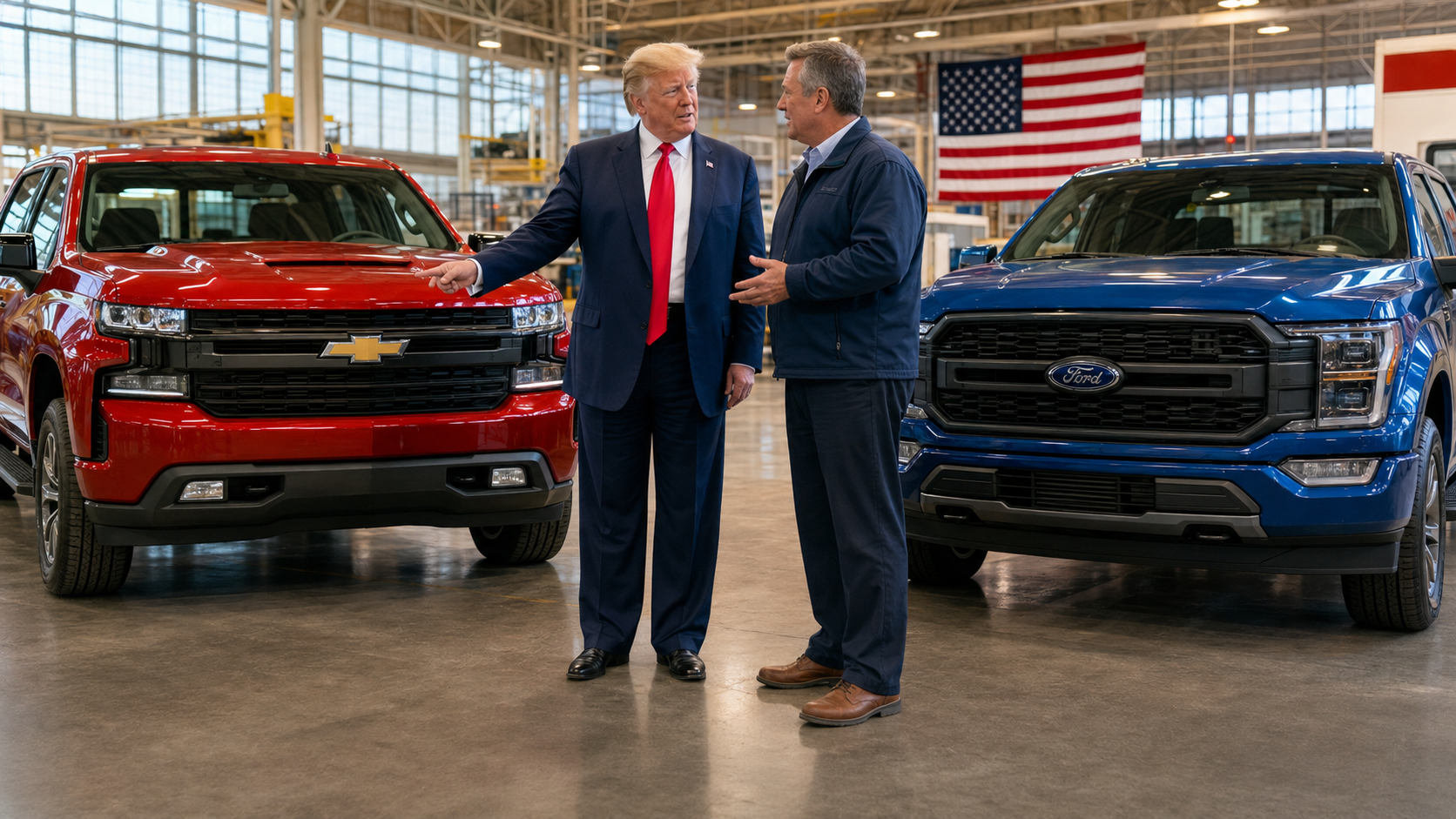
Buying a new car is expensive enough without leaving a tax break on the table. Under a provision signed into law by President Donald Trump, qualifying buyers can deduct up to $10,000 in auto-loan interest annually from 2025 through 2028. The deduction is available whether you itemize or take the standard deduction, but it reduces taxable income rather than providing a dollar-for-dollar tax credit.
There are several catches. The vehicle must be new, purchased for personal use, and finally assembled in the United States. The loan must have originated after December 31, 2024, and income phaseouts begin at $100,000 for individual filers and $200,000 for couples filing jointly. Before counting on the savings, buyers need to check the specific vehicle, financing, and likely tax benefit.

©Ground Picture/Shutterstock.com
What Trump’s Auto Loan Deduction Actually Does
Trump’s auto loan break does not put $10,000 back in your pocket, and it does not lower the price of the car. For tax years 2025 through 2028, qualifying buyers can deduct up to $10,000 of eligible vehicle-loan interest paid during the year. The deduction lowers taxable income, much like other deductions, rather than cutting taxes dollar for dollar. It is available whether you itemize or take the standard deduction and is claimed on Schedule 1-A. Current IRS proposed rules treat the limit as $10,000 per tax return, not per vehicle. Your actual benefit depends on the interest paid, income phaseout, and tax bracket.
“American-Made” Means Final Assembly in America
Here is the part most buyers could easily misunderstand. “American-made” does not depend on the badge, the company’s headquarters or where most of the parts came from. For this deduction, the vehicle must complete final assembly in the United States. That means a foreign-brand vehicle assembled at an American plant may qualify, while a familiar American-brand model assembled abroad may not. Buyers can check the final assembly point on the vehicle information label at the dealership or enter the full 17-character VIN into NHTSA’s free VIN Decoder. Do this for the specific vehicle, not simply the model name, because assembly locations can vary within the same lineup.

Which Vehicles and Loans Qualify
The deduction covers a new car, minivan, van, SUV, pickup truck or motorcycle with a gross vehicle weight rating below 14,000 pounds. Gas-powered, hybrid and electric vehicles can qualify because the law does not impose a fuel-type requirement. The vehicle’s original use must begin with the taxpayer, and it must be bought for personal use. The financing must have originated after December 31, 2024, must have been used to purchase the vehicle and must be secured by a first lien on it. The deduction applies to qualifying interest that is actually paid or accrued during the year, not the car’s purchase price, down payment, principal payments or the total amount financed.
The Income Limits That Can Shrink the Deduction
The full deduction is not available at every income level. It begins shrinking when modified adjusted gross income, or MAGI, exceeds $100,000 for most individual filers or $200,000 for married couples filing jointly. The reduction is $200 for every $1,000, or portion of $1,000, above the threshold. A single filer with $110,000 of MAGI would lose $2,000 of the otherwise available deduction. Someone eligible for the full $10,000 cap would see it completely eliminated by $150,000 of MAGI, or $250,000 on a joint return. A smaller interest deduction can disappear sooner, so buyers should estimate MAGI instead of looking only at salary.

©pathdoc/Shutterstock.com
How Much Buyers Could Actually Save
The $10,000 figure sounds much larger than the tax savings most buyers will see. This is a deduction, not a tax credit, so its value depends largely on the taxpayer’s marginal federal income-tax rate. If a qualifying buyer deducts $3,000 of interest and falls in the 22% bracket, the deduction could reduce federal income tax by about $660. At a 12% rate, the same deduction would be worth about $360. Even a full $10,000 deduction would be worth roughly $2,200 at a 22% rate before any phaseout. Paying interest solely to capture the deduction makes little sense. A lower vehicle price and APR can save more than the tax break.
Records and Paperwork Buyers Will Need
Buyers should keep the purchase agreement, loan documents, VIN, vehicle details and proof that final assembly occurred in the United States. They will also need a lender statement showing how much qualifying interest was paid during the year. The deduction is calculated in Part IV of Schedule 1-A and carried to the federal return. Beginning with 2026 reporting, lenders receiving at least $600 of interest on a covered loan generally use the new Form 1098-VLI, Vehicle Loan Interest Statement. Interest below $600 may still qualify even when the lender is not required to issue the form, which makes personal records important. Save the dealer label or VIN Decoder result with the tax file.
Used Cars, Leases and Other Purchases That Do Not Count
Used vehicles do not qualify, even when they were originally assembled in the United States. Neither do lease payments, fleet financing, a vehicle bought strictly for commercial use, a vehicle with a salvage title or one intended for scrap or parts. Paying cash produces no loan interest to deduct, and a loan taken out before January 1, 2025, misses the origination-date requirement. A general personal loan that is not secured by the vehicle also fails the rule. Refinancing a qualifying auto loan can generally preserve the deduction, but only interest tied to the remaining eligible balance qualifies. Cash taken out during refinancing does not create additional deductible vehicle debt.

©Gorodenkoff/Shutterstock.com
Why Dealers and Lenders Need Accurate Vehicle Data
This deduction turns information that once looked routine into tax data. Dealers need to identify the correct VIN, final assembly location and new-vehicle status before telling a buyer that a purchase qualifies. Lenders receiving at least $600 of interest on a covered vehicle loan generally must report the borrower, interest received, opening principal, loan-origination date and the vehicle’s year, make, model and VIN. That information also goes to the borrower on Form 1098-VLI. A wrong VIN or assembly location can create a mismatch when the taxpayer files. Clear handoffs between the dealer, lender and buyer matter because the IRS, not the salesperson, ultimately decides whether the deduction is allowed.
What Buyers Should Check Before Signing
Before treating the deduction as part of the deal, run the exact VIN through NHTSA’s decoder and check the assembly label on the vehicle. Confirm that it is new, below the 14,000-pound limit and being financed for personal use through a loan secured by the vehicle. Then estimate the first year’s interest, expected MAGI and likely tax bracket. Ask the lender how the annual interest statement will be delivered and save the purchase and loan documents. Most importantly, compare the out-the-door price, APR, term and monthly payment without assuming a tax break. The deduction can improve a deal that already works, but it should not be the reason to overpay or accept a longer, more expensive loan.
