
© Jacob Lund/Shutterstock.com
Key Points
- There is no question that Lean is one of the most savvy business methodologies to improve the bottom line.
- Adopting Lean in any business, manufacturing, or otherwise can help eliminate waste.
- The hope is that by incorporating Lean, customer satisfaction will improve as well.
In a business and manufacturing world that is more competitive than ever, there is something about differentiating your business from others to increase profits. While it’s not exclusive to manufacturing, those in manufacturing have come to praise the rise of Lean, which has not only helped eliminate waste but has also boosted the bottom line.
For businesses all over the country, there is a growing urgency to find the right improvements that will give them an edge. These businesses have already learned or are about to learn that doing nothing and maintaining the status quo will result in lost customers and a lot more red ink than ever before.
Understanding Lean Methodology

At the end of the day, Lean methodology is centered around maximizing customer value by minimizing or eliminating waste in processes. For the most part, Lean tends to be very popular in manufacturing, where it has become synonymous with the opportunity to continuously improve by eliminating non-value-adding processes.
The benefits of Lean methodology typically come out in one of five different ways, though this number can be argued pretty convincingly that there might be more benefits you can name.
Increased Efficiency
If you are looking to identify and eliminate existing waste in your business, Lean methodology is a great place to start. The entire purpose of this practice is to streamline your existing processes, resulting in overall efficiency.
This is instead of creating entirely new processes, which require time to train, perfect, and may ultimately negatively impact the bottom line, at least in the short term. Done right, increasing efficiency should help a business increase profits while improving overall output with fewer resources.
Improved Quality
One of the biggest benefits of Lean is that it places a heavy emphasis on delivering the right amount of value to a business and its customers. It’s this that helps organizations look at how to make the right amount of improvements in their products that can, in turn, drive more profits to the bottom line.
If done right, organizations that look to implement Lean principles can do so in a way that increases the overall experience customers feel, which means increased loyalty and word-of-mouth marketing that can drive revenue in a big way.
Cost Reduction
There is a definite benefit of Lean that allows for cost reduction, which is undoubtedly one of the most important ways companies can see an increase in profits. Any opportunity to decrease costs, like reducing overall inventory or stopping overproduction, can lead to an immediate bottom-line impact.
Improved Customer Satisfaction
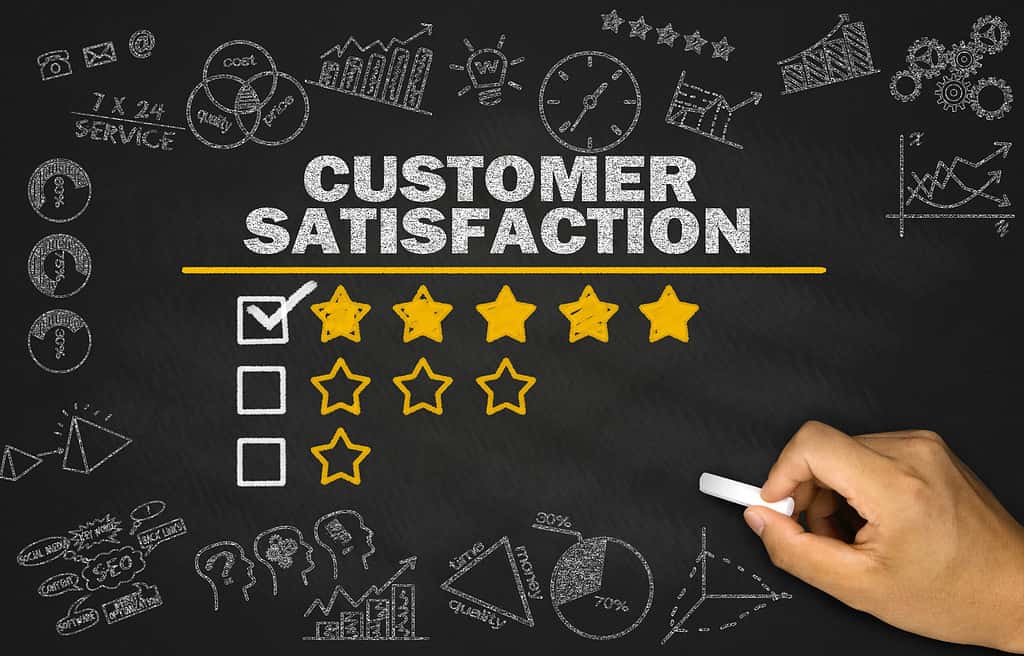
Arguably, the biggest benefit of Lean that most people are going to see is the improvement in customer satisfaction. While Lean might seem like it’s mostly focused on manufacturing, depending on who or what you are reading, the reality is that improving customer satisfaction is the number one focus of any Lean activity.
After all, without customers, improving all of the processes in the world won’t matter if people aren’t buying what it is you are selling.
Engaged Employees
For any company to be profitable or successful, it is clear that employees have to be engaged and interested in any new processes. Asking employees to make continuous improvements takes a level of engagement that makes employees not just feel like they are involved in decision-making, but also actively involved in decision-making.
Employees who feel empowered are going to be the ones most likely to find new ways to help the bottom line grow.
Boosting the Bottom Line
Eliminating Waste
©Toasted Pictures/Shutterstock.com
At the very heart of any Lean methodology, manufacturing or otherwise, is the desire to eliminate waste, and this isn’t just talking about physical waste. To be clear, waste is anything that won’t add value to the customer, and this can be identified in any number of ways.
Among the most popular ways to reduce waste in the Lean world is through Just-In-Time manufacturing. This process allows companies to reduce their overall inventory costs and free up capital to invest in other, more profitable areas, or invest in areas such as research and development.
There are also opportunities available to eliminate waste, like implementing quality control measures in a manufacturing process that reduces the number of defects. Any instance in which a company has to scrap materials has an associated cost, and this cost can reduce the bottom line.
Improving Quality
In yet another step to boost the bottom line, Lean emphasizes a certain level of quality with everything. By sticking to this idea, companies can deliver output that is not only of high quality but also has reduced costs associated with limiting the number of defects, which in turn reduces the number of customer returns.
At the very top of this list is going to be Total Productive Maintenance, which looks like it confirms that every piece of equipment a company is responsible for is well-maintained and optimized to prevent any quality issues. This might mean ensuring regular maintenance checks to prevent any preventable shutdowns or equipment malfunctions.
Continuous Improvement
If you’re tired of seeing the words continuous improvement, you have to get used to the idea that this language is here to stay. Whether it’s through Value Stream Mapping or Kaizen events, this is arguably the most important aspect of Lean’s ability to improve your bottom line.
With Value Stream Mapping, you are going to take a long, hard look at the entire way materials are currently flowing through each process right now and how they eventually land in a customers hands. Are there defects or processes that can be eliminated? This is the step to try and catch what might have otherwise been missed in any other step.
The same goes for Kaizen events, another popular methodology under the Lean umbrella that looks to address very specific issues or processes on an individual level. By taking action here, you will reduce overall operational costs and increase productivity, which directly leads to more profits.
Better Inventory Management
Using Just-In-Time production or Kanban systems will significantly help in this fourth step of boosting the bottom line using Lean methodologies. Just-In-Time is going to help by making sure that goods are only being produced so they can be delivered to customers on time, in the exact quantity they expect, with the exact quality they have long expected.
Separately, a Kanban system is going to take visual signals and convert them to a trigger that indicates more material needs to be produced at any given time. The hope is that by doing so, a company will see improved cash flow by not producing excess levels of inventory that just sit in warehouses or on retail backshelves indefinitely.
Instead of producing excess inventory, a company can use this freed-up cash to invest in other areas, like its employees.
Employee Productivity and Engagement

Ultimately, going through Lean isn’t just about manufacturing or other behind-the-scenes processes, but it’s also about the people involved in every step of the workload. Whether it’s through cross-training so the workforce is flexible and can be trained to perform multiple tasks or by standardizing work so that best practices carry through to different “stations” in a workplace, employee productivity plays a huge role in improving the bottom line.
The Bottom Line Impact
When you combine all five of these areas, the cost savings and efficiency improvements start to add up. There is no question that all of these have to be implemented, and it’s not a one-and-done process either, as a company needs to stick to improvements over time.
Making moves to increase efficiency in one quarter only to see the same waste levels reappear in the second quarter is going to be a real easy way to take away any bottom-line improvements.
The hope is that companies that believe in Lean can take advantage of all of the knowledge in things like Value Stream Mapping or Kanban to help identify where there is money sitting on the table that can go to the bottom line.
Other Useful Tools and Concepts
If you’re interested in reading more about Lean, then we have good news for you, as there is plenty of information available. You can start with how Lean is saving lives in the healthcare industry and then move on to reading more about how Lean’s untapped potential for innovation will help businesses in the future.
Of course, if you want to try something other than Lean for reading, you can take a good look at how Hoshin Kanri is fitting in in the Agile workplace. Another great late-night read is how Lean Six Sigma black belts are the new problem solvers and change leaders in any organization.
Conclusion
It should go without saying that Lean is a force to be reckoned with as a business methodology, and there is a reason why it’s the most recognizable. The hope is that businesses that adopt this method are doing so in a way that they can continue for years in the hopes of adding far more revenue to the bottom line, all while eliminating waste and improving customer satisfaction.
