Six Sigma Quality Resources for Achieving Six Sigma Results
Click To Learn More About PremiumLinks
 Home > Statistics  > Data / Sampling / Descriptive Statistics Search:
 
 for    
Publications
Marketplace
| iSixSigma
Stuff
| iSixSigma
Blogosphere
| Events
Calendar
| The
Dictionary
| Discussion
Forum
| Find
a Job
| Post
a Job
| Industry
News
| Newsletter
Signup
| Sigma
Calculator
| Online
Surveys
iSixSigma Magazine Signup
 iSixSigma Live!  
  Live! Home
  2010 Summit & Awards
  2010 Energy Forum
  2010 DoD Symposium
 Free Newsletters!  
  Sign Up Now!
  Manage Subscriptions
  New To Six Sigma?
  Six Sigma Q&A
  Cert. Practice Test
  Problem Solving Wizard
 Channels 
  Europe
  Financial Services
  Healthcare
  Military
  Software / IT
 Quality Directory 
  Best Practices
  Certifications/Awards
  Consultants
  Culture Evolution
  Methodologies
  News & Events
  Organizations
  Product/Service Guides
  Statistics & Analysis
   Normality
   Variation
  Tools & Templates
  Voice of the Customer
  Free Whitepapers
 Related Topics 
  Innovation
  Outsourcing/Offshoring
  Business Process Mgt
 Quick Access 
  Help
  Search
  Advertise Here
  Article Archives
  Newsletter Archives
 User Feedback 
  Please suggest site
  improvements.
 
  [ larger form ]

Data / Sampling / Descriptive Statistics

Directory Sponsored Links:


(Sponsor A Directory Link -- Click Here To Find Out How)

  • Online Statistics Textbooks (@)

    Actionable Information From Soft Data
    Engineers, Six Sigma practitioners, and other researchers often work with "hard" data - discrete data that can be counted and legitimately expressed as ratios. But what of "soft" data, things like opinions, attitudes, satisfaction? Can statistical process controls (SPC) be applied here? Can process variation in customer satisfaction, for example, be measured and then reported to management in a meaningful way? Can we leverage "appeal", "responsiveness", or "value for money spent"? The process of turning soft data into information (assuming the data are valid) is two-fold: knowing what to extract and knowing how to display. From George H. Chynoweth, Ph.D. and iSixSigma.

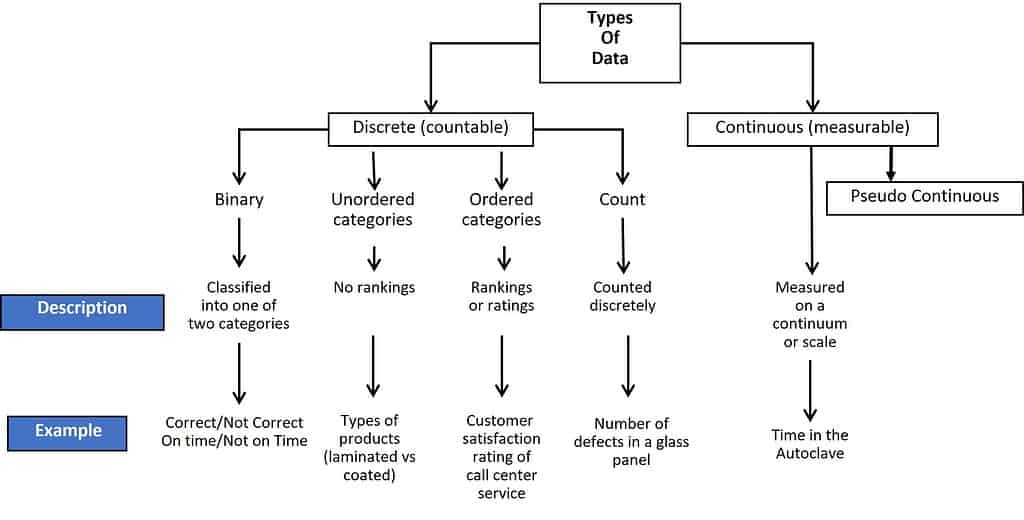
    Analytical Treatment of Discrete Ordered Category Data
    Black Belts learning to apply the Six Sigma methodology to ordered category data should know that there are alternate methods for analyzing discrete ordered category data that are specifically useful when structuring voice of the client processes. From Nilakantasrinivasan.

    Boxplots in Excel
    Examples of how to create boxplots using Microsoft Excel 5/95 and Excel 97. From Neville Hunt, Coventry University.

    Building a Sound Data Collection Plan
    Six Sigma project leaders should develop a sound data collection plan to gather reliable and statistically valid data in the DMAIC measurement phase. Several crucial steps need to be addressed to ensure that the data collection process and measurement systems are stable and reliable -- Learn more here. From Patrick Waddick and iSixSigma.

    Comparing Apples to Apples
    Make sure you attribute your Six Sigma results to the correct factor -- don't compare apples to oranges. From Quality Digest, written by Thomas Pyzdek.

    Data Analysis
    Information and questions on data origination, collection, peer review, comparisons and context. From RobertNiles.com.

    Determining Sample Size
    Microsoft Excel spreadsheet identifying the sample size for given Alpha and Beta Risks. From Mike Carnell.

    Determining Sample Size
    Determining sample size is a very important issue because samples that are too large may waste time, resources and money, while samples that are too small may lead to inaccurate results. Learn how to determine the sample size necessary for correctly representing your population. From iSixSigma.

    Estimating Sample Size for Process Capability with Special Causes
    No valid statistical calculation exists to set a sample size for establishing a baseline for an unstable process. But here is a way to judge if the samples taken are likely to give a reliable result for Process Capability. An Excel template is included. From David Hampton of Rath & Strong.

    Explaining Confidence Interval
    Not sure how to put forward the concepts of confidence interval and degree of confidence to someone who is not comfortable with math? Try this article for a quick and thorough explanation for confidence interval. From the iSixSigma Discussion Forum.

    Fast Start Collecting Data on Financial Service Process
    In any financial service process that is being studied for the first time, it's common for Six Sigma teams to spend one-third to one-half of their project time on data collection alone. Here are three tips that may help teams get a fast started. From Kevin Simonin.

    Finding Data On The Internet
    Look in the right places and you'll find the information you need. If it's out there, it might be here. From RobertNiles.com.

    GE's Six Sigma Focus On Span
    Span is a metric used to understand process dispersion, as well as help a business become focused on customer requirements. From Kerri Simon and iSixSigma.

    Getting Close to the Customer: Quantitative vs. Qualitative Approaches
    After adapting information technology to develop ever more sophisticated quantitative research methods, marketers are taking a second look at more human, qualitative approaches to tapping into the hearts and minds of consumers. From Wharton School of the University of Pennsylvania.

    How To Turn Process Data Into Information
    When we turn our counts and measures into accurate statistical pictures, patterns emerge. Learning to recognize these patterns is an indispensable Six Sigma skill. Valuing the information conveyed by these patterns is one of the most important contributions executive leaders can make to Six Sigma projects. From Daniel Sloan and iSixSigma.

    Is There Bias In Your Random Sample?
    Learn how to randomly sample your population to ensure no bias. From iSixSigma.

    Language Data: The 'Other Data' of Six Sigma
    There is a kind of data that gets less press than the numbers so visible in almost all Six Sigma work – language data. The fact that it receives less exposure doesn’t mean its less worthy of exploration. From David L. Hallowell and Six Sigma Advantage.

    Language Data: The 'Other Data' of Six Sigma - Part 1 of 2 – Nature of Language Data
    There is a kind of data that gets less press than the numbers so visible in almost all Six Sigma work – language data. The fact that it receives less exposure doesn’t mean it is less worthy of exploration. From David Hallowell.

    Moms Know . . . All About Clear Operational Definitions
    An operational definition can be defined as a clear and understandable description of what is to be observed and measured, such that different people collecting, using and interpreting data will do so consistently. It's something moms know about... From Kathy Parker.

    Quick Guide to Boxplots in Excel 97+
    Step-by-step example of how to create boxplots using Microsoft Excel 97+. [PDF file] From The University of Sheffield.

    Rounding and Round-Off Rules
    Simple rules for appropriately rounding your statistical data. From iSixSigma.

    Sample Size Calculation for Non Statisticians
    'So how come a survey of 1,600 people can tell me what 250 million are thinking?' From RobertNiles.com.

    Sampling by Attributes
    This application gives the single and double sampling plans for attributes, according to the Military Standard 105E tables, for a given lot size and AQL. From The Technion.

    Selecting Appropriate Metrics
    Process metrics need to serve a purpose, be understood, and not be too cumbersome or complex to use. Fashioning appropriate metrics requires knowledge, experience and a lot of common sense. These examples are intended to help the inexperienced Six Sigma practitioner recognize the issues involved and the criticality of ensuring that the metrics selected and used at all levels of the organization are the appropriate ones. From Niraj Goyal and iSixSigma.

    Six Sigma Special Topics: Z Shift, Statistics & Non-Standard Data Analysis
    Understanding z shifts, how it applies to your data (which may not be standard), and how to explain it to non-Six Sigma quality professionals. (PDF file: 2.9MB). From C.L. Stanard and GE CRD.

    Small (<30) Sample Size Calculation
    Learn how the Student t Distribution can help you represent your population with a small (less than 30) sample size. From iSixSigma.

    Stability and Linearity
    A couple of key points to an effective measurement system. From PQ Systems.

    Table of the Standard Normal (z) Distribution
    A table of the Standard Normal (z) Distribution for calculating the area under a normal distribution and the critical value. From iSixSigma.

    Tips On How To Explain Normal Distribution
    Tips and various examples on understanding and expaining a normal distribution. From iSixSigma.

    Turning Customer Data into Critical-to-Satisfaction Data
    In Six Sigma, a successful business knows its customers by identifying the voice of the customer (VOC). And, the key to success in that process is gathering customer data and converting it into measurable critical-to-satisfaction elements. From Debra Thomas.

    Use Cases and Measures: Strengthening the Six Sigma Link
    As the functionality described by many use cases begs measurability, creating an early clear link with measures facilitates better understanding of requirements, measurement and test system planning, Y-to-x flowdown and performance prediction. From David L. Hallowell.

    Using Vector Analysis for Turbo-Charged Data Mining
    Data mining via vector analysis is a powerful, flexible process observation tool. With due regard for the possibility of correlation/causation fallacies, data mining can be used by almost anyone. From M. Daniel Sloan.

    Why You Cannot Depend Totally on Statistical Software
    The proliferation of do-it-yourself statistical software is giving some Six Sigma practitioners, who are not strong in statistics, a false sense of confidence. Here are some tips about what needs to be done even before collecting and analyzing data. From Tzippy Shochat.

    Yield the Right Way
    Yields, rolled throughput yields, and other mysteries explained. From Thomas Pyzdek.

    Submit An Article For Publication Here
    Have some tips or an idea that you would like to share with the iSixSigma community? Share it here and help others understand this topic in greater detail.


    "The Bottom Line" Links

    BEST SELLING PRODUCTS (iSixSigma Publications)
    1. Six Sigma Black Belt (DMAIC) Training Slides - 2009 Version!
      The 2009 Six Sigma Black Belt course includes over 40 more slides than the 2008 version. Contents include: 1,220 PowerPo...
    2. Certified Lean Six Sigma Green Belt Assessment Exam
      This assessment exam is useful for students interested in assessing their knowledge of Lean Six Sigma on the Green Belt ...
    3. Certified Lean Six Sigma Black Belt Assessment Exam
      Interested in assessing your knowledge of Lean Six Sigma? Preparing for certifications? Testing your students and traine...
    4. Six Sigma Green Belt Training Slides - 2009 Version
      The 2009 Six Sigma Green Belt course is comprised of: 1122 slides (over 70 more slides than the 2008 version)Instructor...
    5. Certified Lean Six Sigma Black Belt E-book
      In 670 pages learn everything within the Lean Six Sigma DMAIC body of knowledge to successfully achieve Black Belt certi...
    6. Six Sigma DMAIC Training Slides - 2009 Version
      The complete 2009 Lean Six Sigma DMAIC course prepares participants to perform the role of a LSS Black Belt; covering wh...
    7. Kaizen Workshop E-book
      This 150+ page ebook teaches key tools and techniques of Kaizen, as well as real application to enhance learning. Kaizen...
     
  • Six Sigma AdLinks
    AdLinks Information
     
    Home | Discussion Forum | Event Calendar | Job Shop
    Link To iSixSigma | Rate This Page | Report A Problem | Free Content For Your Site | Submit Article For Publishing
     Terms of Service. �2000-2010 iSixSigma. All rights reserved. v3.0lb, 0.0
    About iSixSigmaContact UsPrivacy PolicySite Map